Effective supply chain management is essential for success in the fast-paced, networked corporate environment of today. To meet customer requests while lowering costs and risks, businesses must effectively coordinate the flow of goods, information, and cash. Due to its extensive features, adaptability, and scalability, Odoo, an open-source Enterprise Resource Planning (ERP) system, has become a popular option for supply chain management. This guide covers what Odoo does for Odoo supply chain management, from inventory and purchasing to demand forecasting and integrations.
Inventory with Odoo: Use Odoo Barcode to scan items at receiving, put-away, picking and packing to reduce errors and speed up fulfillment. For multi-location warehouses, Odoo tracks stock by location and lot/serial numbers. For deeper warehouse efficiency, explore our practical guide on how to automate your warehouse with Odoo. Our Odoo integration services and Odoo inventory management capabilities help connect inventory to sales, purchasing and accounting.
3PL and logistics connectors: Odoo integrates with carriers like FedEx and USPS, and with 3PL/logistics partners including C.H. Robinson for freight workflows. These connectors sync shipping rates, labels, tracking and delivery updates so orders flow from Odoo to the right carrier without manual entry.
Inventory reports: Odoo's built-in reports track inventory turnover, slow-moving and aging stock, stock valuation and reorder needs. These reports help prevent stockouts and excess inventory by giving you actionable insights to optimize buying decisions.
Looking for Odoo Implementation, Customization, Integration, or Support Services?
Modules for the Entire Supply Chain
Odoo's extensive array of modules devoted to various supply chain-related topics is one of the primary benefits of using it for supply chain management. The supply chain management modules in Odoo include sections for production, distribution, inventory management, and procurement. These are a few of the essential components that make Odoo a reliable solution:
Inventory Management
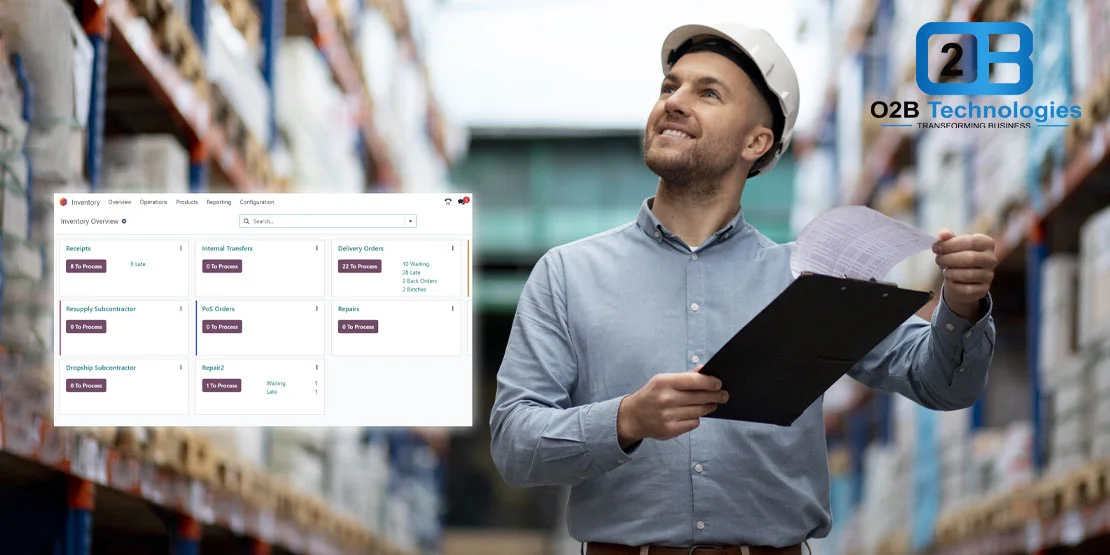
Businesses can track stock levels in real-time, optimize storage, and automate reordering based on customizable rules thanks to Odoo's comprehensive Inventory Management features. Efficiency is further improved with barcode scanning, batch tracking, and multi-location routing. For actionable stock optimization strategies, review our guide on ERP inventory management and stock control.
Purchase Management
Organizations may optimize procurement procedures, manage supplier relationships, and keep track of purchase orders, receipts, and invoices with the purchase management module of Odoo. Tools for vendor evaluation aid in the analysis of supplier performance.
Materials & Manufacturing Management
Production planning, bill of materials (BOM) management, work center scheduling, and quality control are all made possible by Odoo's manufacturing module. Both make-to-order and make-to-stock production techniques are supported.
Sales Management
The Sales Management module of Odoo effortlessly combines sales orders, quotes, and customer communications. Customers' delivery guarantees are accurate thanks to real-time stock availability.
Quality Control
Checks for quality control are incorporated into the manufacturing process, enabling organizations to establish quality standards, conduct inspections, and keep products up to par.
Distribution & Logistics
The order selecting, packing, shipping, and tracking processes are conveniently managed by Odoo's distribution module. Additionally, multi-carrier shipping integration is supported.
Real-time Data Integration
The integration possibilities of Odoo are a significant benefit for supply chain management. Data can effortlessly flow across various supply chain operations and other corporate processes like finance, sales, and Customer Relationship Management (CRM) thanks to Odoo's single platform. Through this integration, data silos are removed, manual data entry is decreased, and correct and current information is made available across the business.
Effective supply chain management depends on real-time data, and Odoo excels in this area. Businesses can access vital supply chain information in real time, manage order status, and keep an eye on inventory levels; this real-time visibility enables better decision-making, improved customer service, and the capacity to react swiftly to shifting market conditions.
Adaptability and Customization
Every company has different requirements and supply chain operations. Odoo is a great option for firms wishing to customize their supply chain management system to their unique requirements due to its open-source nature and flexibility. Workflows, data fields, reports, and dashboards may all be altered in Odoo to fit the procedures and preferences of your company.
Businesses can work with O2B Technologies, an expert Odoo service provider, to tailor Odoo to suit specific supply chain requirements. Odoo's versatility lets the system adapt to your business rather than the other way around. Whether you are developing customized reports, modifying workflows, or adding specialized features, the platform adapts to your operational workflows.
Scalability and Growth
Businesses' supply chain requirements evolve as they expand. Odoo's scalability ensures it can meet the evolving needs of a developing organization. The platform scales easily whether you need to add warehouses, enter new regional markets, or launch new product lines.
By deploying Odoo in a way that anticipates future development, O2B Technologies can assist organizations in making plans for scalability. By doing this, you can make sure that your supply chain management system continues to match your business's expansion plans.
Improved Communication and Collaboration
Supply chain management requires smooth cooperation and communication between numerous stakeholders, including suppliers, manufacturers, distributors, and customers. Odoo has built-in collaboration capabilities like message boards, document management, and messaging to make it easier for supply chain teams to communicate with one another.
Odoo helps supply chain partners coordinate better, cuts down on communication delays, and boosts overall supply chain effectiveness by offering a single platform for collaboration and communication.
Robust Reporting and Analytics
Making wise supply chain decisions requires access to timely and insightful information. Businesses may design unique reports, dashboards, and key performance indicators (KPIs) to track the performance of their supply chains thanks to Odoo's reporting and analytics features.
Businesses can work with O2B Technologies to make the most of Odoo's reporting and analytics tools in order to improve inventory levels, track supplier performance, and gain deeper insights into supply chain KPIs.
Budget-Friendly Option
A practical option for supply chain management is provided by Odoo. Businesses are better able to control costs when pricing is transparent and hosting options are available. Additionally, the initial investment in Odoo may be recovered by cost savings brought on by automation, increased effectiveness, and decreased errors.