What Is an Open-Source ERP?
Organizations are continually looking for methods to optimize their operations, increase efficiency, and simplify procedures in today's fast-paced and competitive business climate. Systems for Enterprise Resource Planning (ERP) have become crucial resources for achieving these objectives. While there are numerous ERP options on the market, open source ERP has become quite popular because of its distinctive benefits. We'll discuss what an open source ERP is, how it functions, and why it's revolutionized corporate operations in this blog article.
Looking for Odoo Implementation, Customization, Integration, or Support Services?
Open Source ERP at Its Core
An open source ERP (Enterprise Resource Planning) system uses an open source software architecture to manage essential corporate operations including finance, Human Resources, purchasing, and production.
What open source means for a business: You can see and change the source code to suit your processes, there are no license fees for Community edition, and you have access to a large global developer community with thousands of ready-made apps.
Using Open Source ERP
Open source ERP runs on a collaborative and modular system. This is how it goes:
Modular by design
Open source ERP is modular, with each module addressing a particular business function. These programs could include finance, production, Sales, inventories, and other topics. Depending on their own requirements, organizations can decide which modules to adopt.
Customization
Because the software is open source, businesses may exactly fit the ERP system with their company operations. This is accomplished by gaining access to the system's source code and making changes to it to meet certain requirements.
Community Collaboration
Open source ERP is powered by an active global community of developers, partners, and users who continuously build, audit, and improve the software. This collaborative approach yields thousands of specialized community modules, rapid bug resolutions, and regular feature updates.
Integration
Open source ERP systems are made to easily work with other systems and software programs. This guarantees seamless data flow across the company, minimizing mistakes and the need for manual data entry.
Scalability
As a company expands, its ERP requirements change. Since open source ERP systems are very scalable, businesses may add or change modules and features to meet evolving needs and expand their operations.
The benefits of open-source ERP
Open source ERP is an appealing option for organizations due to a number of significant benefits it provides:
Cost-effective
Because open source ERP is often free to download and use, the initial cost for software licensing is reduced. While charges for Customization, support, and hosting may exist, open source ERP remains a cost-effective solution.
Transparency
You can see and change the source code, which allows organizations to understand how the software works and make modifications to meet their exact needs.
Versatility
Open source ERP solutions are extremely adaptable, allowing organizations to modify the software to their own business processes and requirements. This versatility is especially useful in sectors with distinct operations.
Community Support
The global developer and user community contributes to continuing support and development, ensuring that the software is current, secure, and useful.
Capabilities for Integration
Open-source ERP systems are built to connect smoothly with other business software applications, encouraging efficient data flow and eliminating operational redundancy. Explore our Odoo integration services for connecting third-party platforms.
Scalability
Organizations may extend their open source ERP systems as needed, adding or updating modules to meet growth and changing needs.
Vendor Lock-In
Unlike proprietary ERP systems, open source ERP allows organizations to swap service providers or customize the software on their own, eliminating vendor lock-in concerns.
Open Source ERP Solutions That Are Popular
A number of open source ERP solutions have achieved popularity in the commercial sector. Some of the more noteworthy examples are:
Odoo
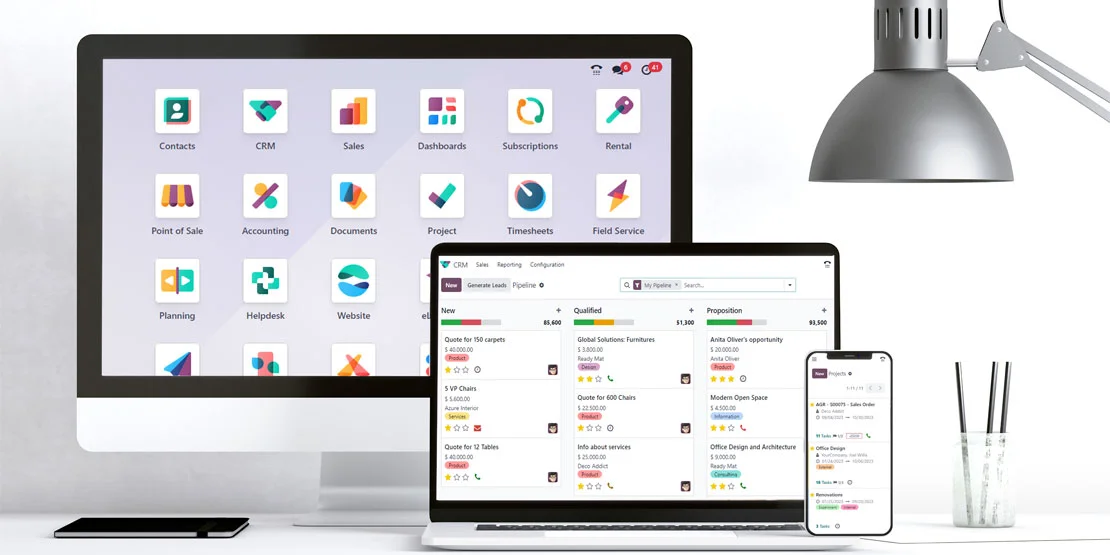
Odoo is a leading modular ERP system used by over 12 million users worldwide, covering a wide range of company operations such as CRM, Accounting, and inventory management.
Community vs. Enterprise: Odoo Community is free and open source under the LGPL license, covering core business functions.
Odoo Enterprise adds advanced modules, mobile apps, automated database upgrades, and official support under a per-user subscription (see odoo.com/pricing).
Essential Odoo Business Applications
- CRM: Track leads through visual pipelines, log customer interactions, and automate follow-ups.
- Sales: Create professional quotations, manage customer orders, and convert approved quotes into invoices.
- Inventory: Monitor real-time stock levels across multiple warehouses with automated replenishment and barcode support.
- Project: Organize tasks on Kanban boards, track billable hours, and coordinate team deliverables.
- Accounting: Automate bank synchronization, manage customer invoicing, track expenses, and generate financial reports.
- Purchase: Manage vendor relationships, automate purchase orders, and track receipt of goods against supplier bills.
- Helpdesk: Track customer support tickets, manage response SLAs, and monitor support team performance.
Comparing Open-Source ERP Options
Different open-source ERP systems are engineered for different organizational sizes, technical capabilities, and operational requirements. Here is a fair comparison of who each option fits best:
- Odoo: Best suited for growing businesses and enterprises seeking a highly modular suite where they can start with essential apps and scale seamlessly via thousands of community and enterprise modules.
- ERPNext: Best suited for small and medium-sized enterprises (SMEs) that want an integrated, out-of-the-box system with built-in manufacturing, accounting, HR, and CRM without complex setup.
- Apache OFBiz: Best suited for mid-sized to enterprise-level organizations with internal software engineering teams needing a flexible, customizable Java-based enterprise framework.
- Dolibarr: Best suited for freelancers, micro-enterprises, and small businesses looking for an easy-to-deploy, lightweight ERP/CRM system to manage invoices, quotes, and contacts.
Implementation Best Practices
To maximize the long-term value of an open-source ERP deployment and prevent operational roadblocks, organizations should adhere to two essential practices:
- Plan Customization Wisely: Tailor workflows where they deliver genuine competitive advantage, but avoid unnecessary modifications to standard logic—heavy custom changes increase technical complexity and make future version upgrades significantly harder.
- Establish an Ongoing Maintenance Plan: Implement a clear schedule for applying security patches, testing backups, and keeping underlying dependencies updated so the ERP remains stable, performant, and protected.