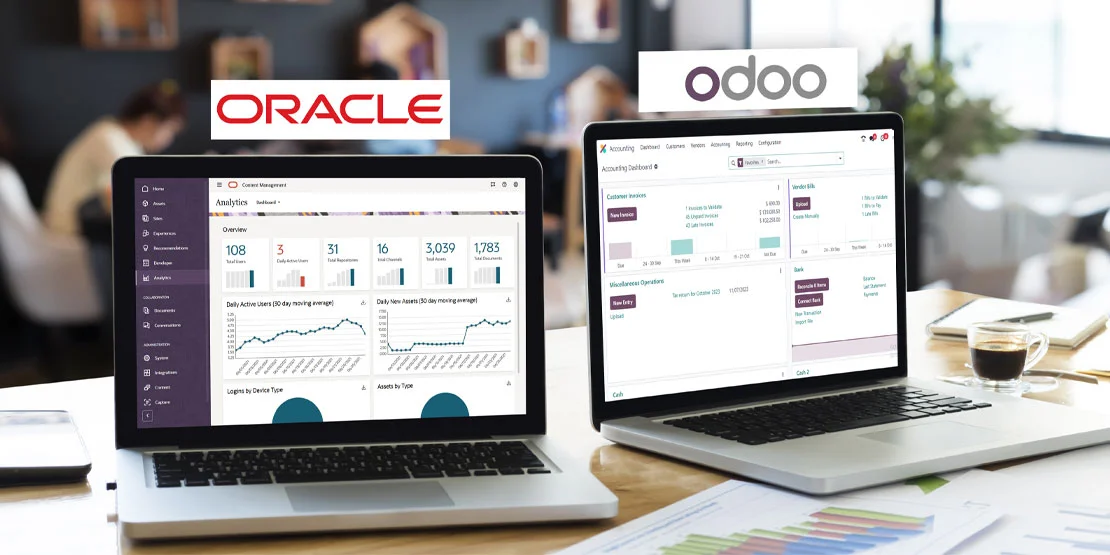
What is the difference between Oracle and Odoo?
Selecting the right enterprise software is a crucial decision for any business. Among the various options available, Oracle and Odoo are two popular choices, each offering a unique set of features and capabilities. In this blog post, we'll explore the key differences between Oracle and Odoo to help you make an informed decision based on your organization's specific needs.
Looking for Odoo Implementation, Customization, Integration, or Support Services?
Scope and Purpose
OracleOracle Corporation is a global technology company known for its wide array of software products and services, including databases, cloud infrastructure, and enterprise software applications. Oracle's ERP (Enterprise Resource Planning) software, such as Oracle E-Business Suite and Oracle Cloud ERP, primarily focuses on financial management, supply chain, and human resources.
Odoo Odoo is an all-in-one open-source ERP solution designed to cover a broad spectrum of business operations, including accounting, sales, Inventory Management, CRM (Customer Relationship Management), e-commerce, and more. Odoo's primary goal is to streamline and optimize internal business processes across various industries and business sizes.
Cost and Licensing
Oracle Oracle is known for its substantial licensing and implementation costs, which can be a significant investment for businesses, particularly large enterprises. Licensing fees are often based on factors such as the number of users and specific features required.
Odoo Odoo offers a cost-effective alternative, especially for small to medium-sized businesses (SMBs). The community edition of Odoo is open source and free to use, providing Businesses with an affordable entry point. While there are paid versions with additional features and support, Odoo's overall cost is typically lower than that of Oracle.
Customization and Flexibility
OracleOracle ERP systems offer a high degree of customization but may require extensive consulting and development efforts. Customizations often involve complex coding and can be time-consuming and costly.
OdooOdoo is highly customizable and flexible, allowing businesses to tailor the software to their specific processes and workflows. Users can easily add custom fields, workflows, and reports without extensive coding, making it more accessible for non-technical users.
User-Friendly Interface
Oracle Oracle's user interface has improved over the years but is still considered complex by some users. Extensive training may be necessary to navigate and use the system effectively.
Odoo Odoo is renowned for its user-friendly interface, designed to minimize the learning curve for users, whether Technical or non-technical. Its intuitive design promotes rapid adoption within organizations.
Integration Capabilities
Oracle Oracle ERP systems offer robust integration capabilities with other Oracle products, but integrating with third-party applications may require additional development efforts and costs.
Odoo Odoo provides seamless integration capabilities through its API (Application Programming Interface). This allows for easy integration with other software systems, third-party applications, and external data sources, facilitating a cohesive tech ecosystem.
Scalability
Oracle Oracle ERP solutions are designed to handle the complex demands of large enterprises with vast operations. They can scale to accommodate extensive user bases and complex business processes.
Odoo Odoo is scalable and can adapt to the growth of small to large businesses. Organizations can add new modules and features to their Odoo implementation as needed, ensuring scalability as their needs evolve.
Industry Specialization
Oracle Oracle ERP applications cater to specific industries, offering industry-specific features and functionalities. This specialization makes Oracle a preferred choice for businesses with specialized needs.
Odoo Odoo provides solutions for various industries and can be adapted to suit industry-specific requirements. While it offers a wide range of applications, it may require third-party integrations or customizations for highly specialized industries.
Support and Community
Oracle Oracle has a vast network of certified partners, consultants, and developers, providing extensive support and services. Its support infrastructure is robust, reflecting its enterprise focus.
Odoo Odoo Benefits from a strong global community of users, developers, and partners who actively contribute to its development and growth. Users have access to a network of certified Odoo partners who offer implementation, customization, and support services.