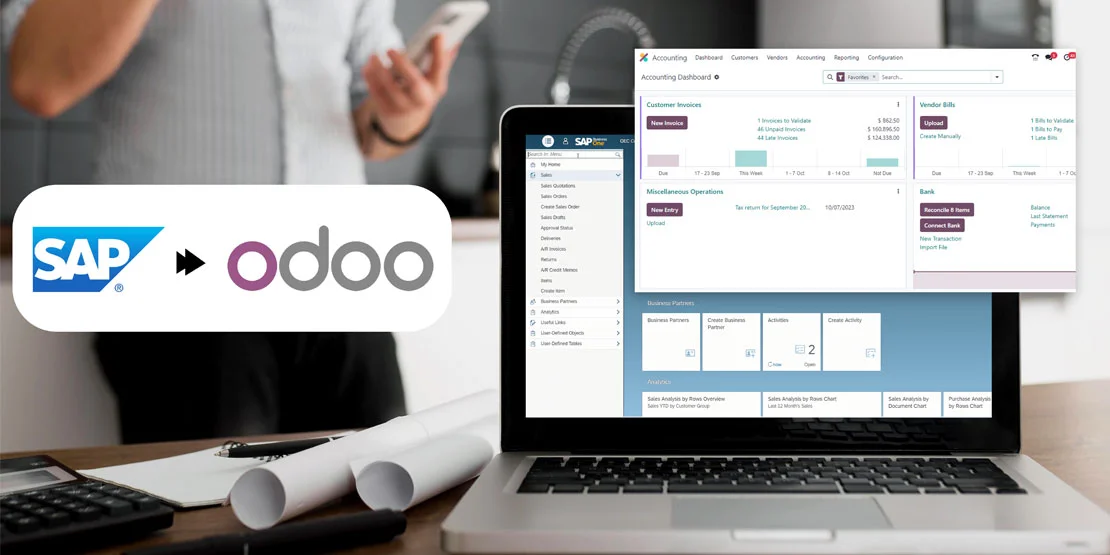
In the world of enterprise resource planning (ERP) software, SAP has long been considered a giant, offering comprehensive solutions to businesses across various industries. However, in recent years, there has been a noticeable shift in the ERP landscape, with an increasing number of companies choosing to migrate from SAP to Odoo. This transition is driven by several compelling reasons that are reshaping the ERP market. In this blog post, we'll explore why companies are making the move from SAP to Odoo.
Still comparing ERPs? See our Odoo vs SAP breakdown, or Odoo vs NetSuite vs SAP for a growing business.
Looking for Odoo Implementation, Customization, Integration, or Support Services?
Lower cost
SAP's licensing and the consultants it needs add up quickly. Odoo's plans are simpler, and for small and mid-size companies the total cost of a working system is usually lower.
Easier to change
Odoo's modular design lets you adapt workflows as your business changes. Changes in SAP often turn into larger consulting projects.
Easier to use
The interface is clean and quick to learn, and native mobile apps come included. Teams usually pick it up faster than SAP's classic screens - and that keeps schedules on track.
Add apps as you grow
Start with sales, accounting and inventory, then add CRM, manufacturing, eCommerce or helpdesk modules when you need them - no new platform required.
Easier integrations
Odoo connects to payment providers, shipping, eCommerce and accounting tools with standard connectors, so building a working tech stack is more direct.
Faster setup and upgrades
Setup for a smaller company is typically quicker than a full SAP project, and upgrades install module by module instead of as one system-wide release.
When SAP still makes sense
Odoo isn't the answer for every SAP user. SAP may still be the better fit when:
- You're a very large global company with operations across many countries.
- Heavy industry rules are built deep into your SAP setup.
- You've already invested heavily in SAP and have an in-house SAP team.
How a move from SAP to Odoo works
- Review what you use in SAP - list the modules, reports and custom code you actually rely on.
- Clean your data - export your master data and fix it before anything moves.
- Set up Odoo and move your data - configure the modules, run test imports and validate the results.
- Train users and go live in phases - start with core apps, add the rest after go-live.
Small data slips at step 2 sink projects later - see the most common data migration mistakes. A typical move takes about 16 weeks - see our Odoo implementation timeline.