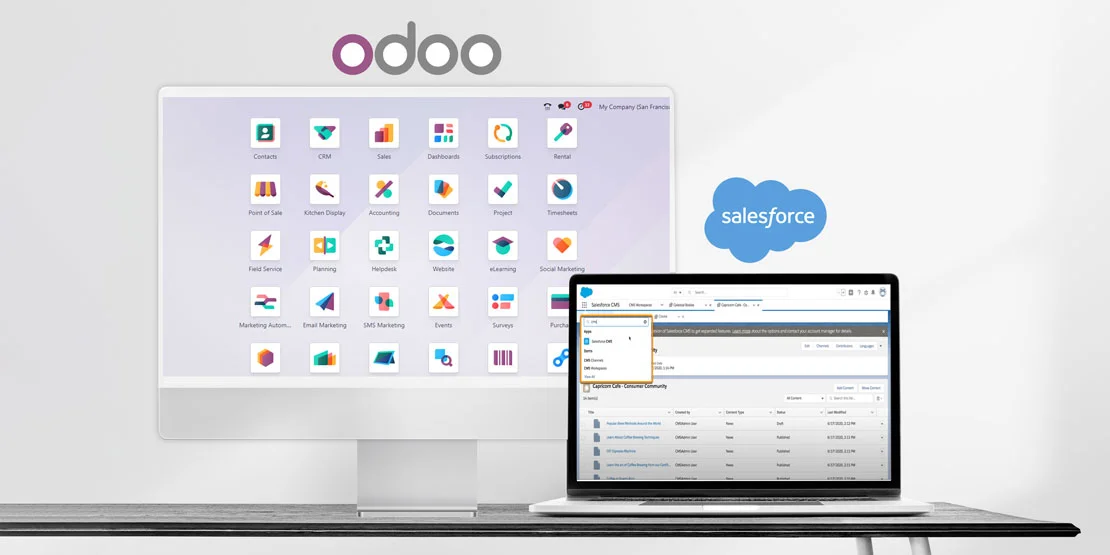
Odoo vs Salesforce: How Do They Compare?
Selecting the right software for your business can be a challenging task, especially when you're comparing two popular solutions like Odoo and Salesforce. Both offer a range of features and capabilities, but they cater to different aspects of business management. In this blog post, we'll conduct a thorough comparison between Odoo and Salesforce to help you make an informed decision based on your specific needs.
| Feature | Odoo | Salesforce |
|---|---|---|
| What it is | All-in-one ERP (CRM, sales, inventory, accounting, HR…) | CRM platform (sales, service, marketing) |
| Best for | SMBs and mid-size firms wanting one system | Sales-led companies, often large |
| Pricing | Per user; Community edition is free (see odoo.com/pricing) | Per user, per product (see Salesforce's pricing page) |
| Customization | Studio and code (Python) | Point-and-click and code (Apex) |
| Integrations | API and app store | API and AppExchange |
| Accounting and inventory | Built in | Needs other tools |
Looking for Odoo Implementation, Customization, Integration, or Support Services?
Core Purpose
Odoo: Odoo is an all-in-one open-source ERP (Enterprise Resource Planning) solution. It covers a wide spectrum of business operations, including accounting, inventory management, human resources, CRM (Customer Relationship Management), e-Commerce, and more. Odoo's primary focus is on streamlining and optimizing internal business processes.
Salesforce: Salesforce is a cloud-based CRM platform designed for managing customer relationships and sales activities. While it offers additional modules and applications (such as Service Cloud and Marketing Cloud), its core purpose is to enhance sales and customer service functions.
Scope of Application
Odoo: Odoo provides a comprehensive suite of integrated applications that encompass various aspects of business management, including Sales, accounting, inventory, manufacturing, and project management. It is suitable for small to large businesses across diverse industries.
Salesforce: Salesforce primarily focuses on CRM functionalities, such as lead management, opportunity tracking, customer support, and marketing automation. While it can be extended with add-ons and integrations, its core strength lies in managing customer relationships.
Customization and Flexibility
Odoo: Odoo is highly customizable, allowing businesses to tailor the software to their specific processes and workflows. Users can add custom fields, workflows, and reports to align Odoo with their unique requirements.
Salesforce: Salesforce also offers a high degree of customization, enabling users to configure fields, objects, and processes to match their business needs. However, some complex customizations may require advanced development skills.
User-Friendly Interface
Odoo: Odoo is known for its user-friendly interface, designed to minimize the learning curve for users. It caters to both technical and non-technical users, promoting rapid adoption within organizations.
Salesforce: Salesforce has improved its user interface over the years, but it still has a reputation for being complex, especially for new users. Extensive training may be required to navigate and utilize the platform effectively.
Cost Considerations
Odoo: Odoo offers a straightforward, user-based pricing model. The Community edition is open source and free to use, while the Enterprise edition is priced per user and includes access to all standard apps rather than charging per module. Implementation, hosting, and customization costs vary by project scope; check current prices on odoo.com/pricing.
Salesforce: Salesforce charges per user, per month for each individual product cloud (such as Sales Cloud, Service Cloud, or Marketing Cloud). Total licensing fees increase as your team grows or requires premium features and higher API call volumes; check current prices on Salesforce's pricing page.
Where Salesforce Is Stronger
A realistic comparison must recognize where Salesforce holds the upper hand:
- Deep CRM capabilities: Salesforce is purpose-built for enterprise customer relationship management, offering market-leading sales pipeline tools, opportunity scoring, deal forecasting, and automated sales sequences.
- A large app marketplace: With the Salesforce AppExchange, organizations have access to thousands of pre-built integrations, specialized extensions, and third-party enterprise tools.
- Big-enterprise sales teams: For large corporations with complex sales hierarchies, global territory models, and multi-team quotas, Salesforce provides the enterprise-grade governance and structure large sales forces rely on.
Integration Capabilities
Odoo: Odoo offers robust integration capabilities through its API (Application Programming Interface). This allows for seamless integration with other software systems, third-party applications, and external data sources, creating a cohesive tech ecosystem.
Salesforce: Salesforce also supports integrations with a wide range of third-party applications and services through its AppExchange marketplace. Integration options are extensive, especially when it comes to CRM-related functions.
Scalability
Odoo: Odoo is designed to scale with your business. Organizations can add new modules and features to their Odoo Implementation as they grow or evolve.
Salesforce: Salesforce is scalable and can accommodate the needs of both small businesses and large enterprises. However, costs may increase significantly as more users and features are added.
Industry Specialization
Odoo: Odoo provides solutions for various industries and can be adapted to suit industry-specific requirements. It caters to businesses in retail, manufacturing, services, and more.
Salesforce: Salesforce focuses on sales, service and marketing. It may require additional third-party integrations for other operational needs like manufacturing or accounting.
Support and Community
Odoo: Odoo benefits from a strong global community of users, developers, and partners who actively contribute to its development and growth. Users have access to a network of certified Odoo partners who provide implementation, customization, and support services.
Salesforce: Salesforce also boasts a vibrant ecosystem of certified partners, consultants, and developers. Its support infrastructure is extensive, reflecting its enterprise focus.