Who needs which software?
"Real estate ERP" covers very different businesses, and they don't all need an ERP. The right answer depends on what your company actually does:
Property managers and landlords
You collect rent, run leases, track tenants and handle maintenance requests. A property management tool is usually the better fit here — an ERP is more than you need.
Developers and builders
You juggle projects, budgets, contractors, purchasing and the sale of units. An ERP fits this well, because projects and money live in one system.
Brokers and agencies
You work leads, listings, deals and commissions. A CRM plus accounting usually fits — the setup many professional services firms run.
Software options for US real estate companies
Most US real estate firms choose between property management platforms and full ERPs. These are the names worth knowing:
| Software | Best for |
|---|---|
| Odoo | Developers, brokers and mixed real estate businesses wanting CRM, projects, rentals, accounting and documents in one system |
| Yardi | Large property managers and owners |
| AppFolio | Small and mid-size property managers |
| MRI Software | Commercial and residential property firms |
| Oracle NetSuite | Real estate groups with many entities |
Odoo
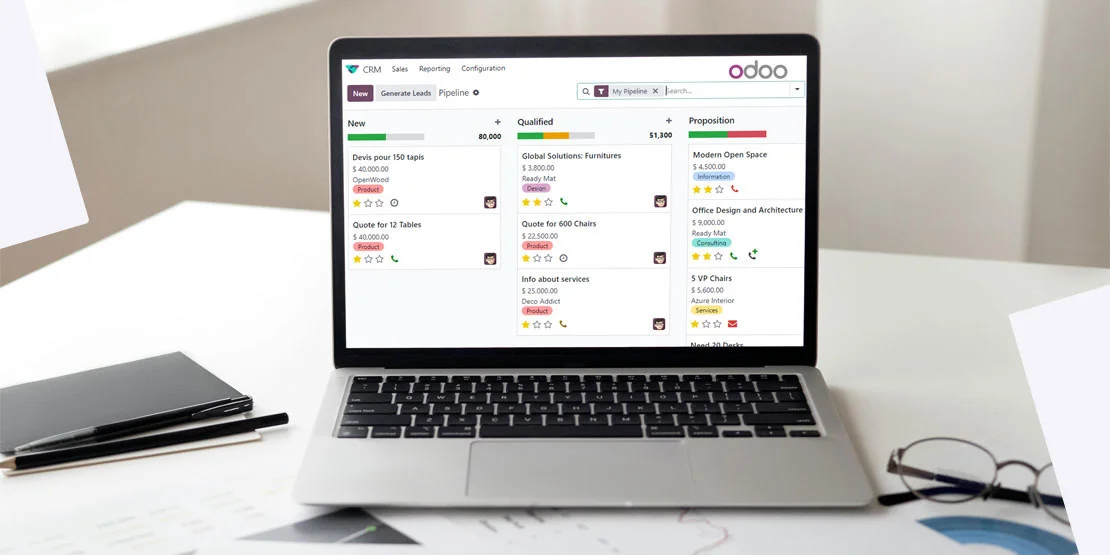
Odoo is an open-source ERP with apps for CRM, sales, projects, invoicing and accounting. For a real estate business, that means leads in the CRM, development jobs in project management, contracts and documents in one place, and full accounting behind it — instead of several disconnected tools. You can start with the apps you need and add more as the business grows.
Looking for Odoo Implementation, Customization, Integration, or Support Services?

Real examples from O2B work
O2B has no real estate case study yet, and these clients are not real estate companies. They are the closest real projects to what developers and brokers need.
Real example: projects linked to billing. A service business — a law firm managing many client projects — needed projects and invoices in one place. O2B connected projects to billing in Odoo. For developers, this same setup is the base of project budgets and milestone billing. Read the case study.
For brokers: smarter contact relationships in Odoo. A professional services firm cleaned up duplicate contacts and linked people to companies in Odoo's CRM — the same problem brokerages have with buyers, sellers and partners. Read the case study.
Our verdict
If you mainly manage rentals, a property management tool like AppFolio or Yardi is usually the best fit. If you develop, sell or broker property and want CRM, projects and accounting in one system, Odoo is a flexible, lower-cost option.
Running a real estate business?
See how Odoo would handle your leads, projects, contracts and accounting.
Key Features to Look for in a Real Estate ERP System
Before the user chooses an ERP system, there are various key features that one should look for, also these key features are essential for the business as they work on numerous components all together to make a well-defined workflow.
Financial Management and Accounting
The ERP system should always offer a strong financial management that not only helps the user to work effectively but also should have access to powerful tools that contribute to the prime functions like integration, customization and implementation.
Project and Program Management
Real estate is one of the vast industries, hence the projects associated with it are also complex. The sector needs an ERP system that gives the access to include multiple stakeholders, offers program management and works on including features such as project planning, resource allocation, and project tracking for a better production.
Field Service Management
If you are someone who is working with the process that includes field service operation, therefore it is very important to have an ERP that offers field service management tools and modules to maintain functions like property, repair, etc.
Travel and Expenses Management
The ERP system should offer travel and expenses management as it helps the user to track the employees travel and expenses effectively, also the ERP should have features that manage expense reporting and reimbursement.
Supply Chain Management
Supply chain management is another important tool that helps the user to work on the deliverables from effectively, the supply chain function contains operations, purchasing, logistics, resource management, etc.
Asset Management
In real estate, asset management means managing properties to improve their value and income over time — maintenance schedules, upgrades, leases and operating costs. An ERP helps by keeping each property's costs, contracts and documents in one place.
Contract Management
The ERP system should have contract management features that assist the user in organizing the real estate contracts effectively, it also helps in crafting the components like negotiation, and renewal.
Human Resources and Payroll
The human resources and payroll feature plays an important role in smooth working of all the employees in the venture as the HR modules works as a bridge between the business and the staff, it manages function like employee records, benefits administration, and payroll processing.
Benefits of Using an ERP System in Real Estate
Using an ERP system can give you numerous benefits in your real estate business when you have the right guide with you. Therefore one can opt for a trusted ERP provider like O2B Technologies that works on providing the best possible solutions and give you a tailored workflow. There is a list of a few benefits that comes along with the ERP system in real estate:
Improved Efficiency
The ERP system helps the user in streamlining the overall process of their business venture through functionalities like task automation, real-time data segregation and more.
Better Decision Making
As the ERP systems, provides an effective segregation of data and maintain a real-time data and analytics. It contributes in making better business decisions that align with the current workflow and processing.
Increased Profitability
As the efficiency of the workflow and data driven solutions are achieved by ERP, the profitability of the venture also increases through the same.
Enhanced Customer Service
ERP systems can help improve customer service as it assists in better communication with customers, providing customer centric data and more.
How to Choose the Right ERP System for Your Real Estate Business
There are several methods that can help you choose the right ERP system for your real estate business; the first one would be to consider your specific needs and requirements and work accordingly. Start simply by understanding them with the factors like the size of your organization, the features you want to implement. The next stage to this process would be researching the different ERP systems, considering their case studies, looking for reviews, considering components like scalable tools that grow with your business requirements and size. Lastly, evaluate the support and training offered by the ERP vendor and work with the one that stands on all your criteria, the ventures can also choose ERP partners like O2B Technologies that works on a tailored approach that gives maximum benefit to the user.
FAQs
Is ERP the same as property management software?
No. Property management software is built for rentals: tenants, leases, rent and maintenance requests. An ERP covers the whole business: CRM, projects, purchasing, accounting and reporting. Property managers usually need the first; developers and brokers often need the second.
Can real estate ERP software improve the decision-making processes?
Yes. It brings sales, projects and accounting data into one place, so reports and margins are based on the same numbers instead of separate spreadsheets.
Do we need a CRM for real estate?
Brokers and agencies usually do: leads, listings, deals and commissions live in the CRM. Developers use it for pre-sales. If you run an ERP like Odoo, its built-in CRM module can handle this.
How can real estate ERP software help my business scale?
One system keeps working as deal volume, projects and entities grow, without adding a new disconnected tool for each step.