Foundries track a different set of facts from other manufacturers: which heat produced which casting, what chemistry the spectrometer found, which pattern was used and how much metal was poured versus shipped. An ERP that cannot hold those records leaves the foundry reconciling spreadsheets after every shift.
This guide covers six systems US foundries shortlist in 2026, plus the capabilities to test in a demo. Fabricators shape metal; foundries cast it, and our best ERP for metal fabrication guide covers cutting, nesting and welding instead.
Looking for Odoo Implementation, Customization, Integration, or Support Services?
What foundries need from ERP
Foundry requirements are specific. Test these eight areas in any demo before comparing price:
Heat and melt tracking
Link each heat number to the castings it produced, so a customer question or quality issue can be traced back to the melt.
Alloy chemistry
Store spectrometer results per heat and attach certificates to each shipment, instead of keeping chemistry in a separate lab system or binder.
Pattern and tooling records
Track location, owner (customer or foundry), condition and expected life for every pattern and tool.
Casting yield
Compare poured weight with shipped weight, and see yield by part, pattern and shift.
Scrap and rework by defect type
Record scrap and rework against a defect reason, so the biggest loss is visible rather than buried in a total.
Costing by weight and metal surcharges
Cost parts by weight and apply metal surcharges when alloy prices move, instead of rebuilding margin calculations in a spreadsheet.
Outside processing
Track heat treat, machining and coating sent to outside vendors, including quantities, returns and cost.
Traceability for audits and customers
Produce heat-to-shipment traceability and certificates quickly when a customer or auditor asks.
6 ERP systems for metal foundries
| # | Vendor | Best for | Watch out for |
|---|---|---|---|
| 1 | Odoo | Small and midsize foundries wanting MRP, quality, lots and accounting in one system | Heat and chemistry records need setup or custom work |
| 2 | Epicor Kinetic | Make-to-order foundries with complex routing | Setup effort |
| 3 | Infor CloudSuite Industrial (SyteLine) | Mid-size and larger metal producers | Enterprise pricing |
| 4 | Microsoft Dynamics 365 Business Central | Foundries on Microsoft 365; add-ons from partners | Depends on the add-on |
| 5 | SAP Business One | Mid-size foundries with SAP partners nearby | Industry add-ons cost extra |
| 6 | Oracle NetSuite | Multi-site metal groups | Higher cost |
O2B is an Odoo partner. Capabilities vary by edition, configuration and add-ons, so ask each vendor to demonstrate heat traceability, chemistry records, yield reporting and scrap analysis with your own part numbers.
We do not list vendor prices here because licensing depends on users, modules and contract terms. Odoo license details are on Odoo's pricing page.
How Odoo fits a foundry

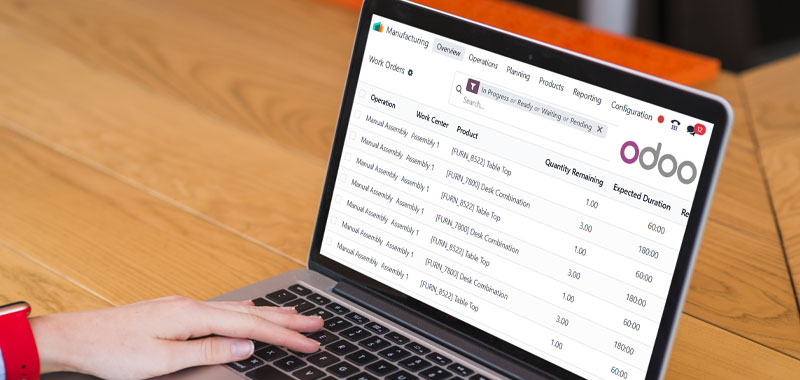
Odoo combines manufacturing orders, bills of materials, lot and serial tracking, quality checks, inventory and accounting in one system. A foundry can model a heat as a lot, attach spectrometer results as quality checks, and let that lot follow the castings through outside processing and shipment.
Casting yield, scrap by defect and metal surcharges usually need configuration or a small custom app, because Odoo is general-purpose manufacturing software rather than a foundry-specific package. Odoo Community is open source; Odoo Enterprise adds licensed apps and hosting options. Open-source licensing and cloud hosting are separate choices.
See Odoo for manufacturing for the industry setup, our Odoo MRP guide for planning, and Odoo implementation services if you want help scoping heats, patterns and quality checks.

O2B example: RAM process in Odoo
O2B reworked a manufacturing client's RAM process in Odoo, and cycle times dropped by 40%. This was a general manufacturer, not a foundry.
Our verdict
Small and midsize foundries can run on Odoo with setup for heats and chemistry. Foundries with complex routing and many outside steps usually shortlist Epicor or Infor.
Tracking heats and pattern records on paper?
See how Odoo handles them, from lot traceability and quality checks to yield and scrap reporting.
Frequently asked questions
Can ERP link heats to castings?
Yes, with lot tracking. Each heat number becomes a lot that follows the castings through production and shipment.
Can ERP store chemistry results?
Yes. Spectrometer results can be stored as quality checks or attachments on each heat lot, and pulled into certificates for shipments.
How is a foundry ERP different from metal fabrication ERP?
Foundries need melt, chemistry and pattern tracking; fabricators need cutting, nesting and welding steps.