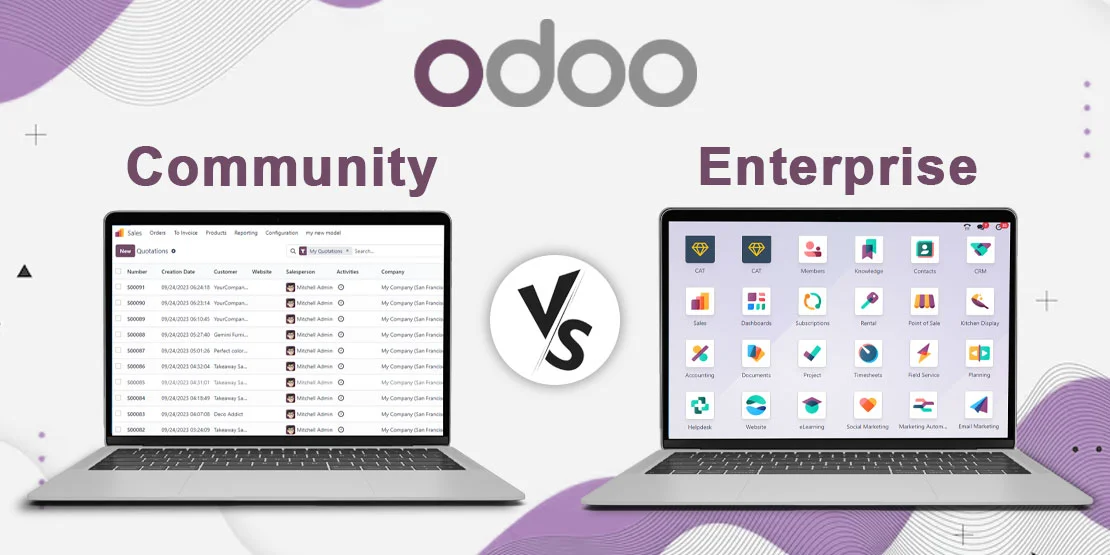
When businesses decide to implement Odoo, one of the first major decisions they also face is choosing between Odoo Community and Odoo Enterprise. Both editions are powerful, flexible, and widely used, but they also serve different business needs.
Understanding the differences between Odoo Community and Enterprise is essential before making your Odoo implementation decisions. While the community is free and open source, the enterprise offers advanced features, official support, and scalability advantages.
In this guide, we’ll break down Odoo Community and Enterprise, which is essential when making your Odoo implementation decisions. While Community is free and open source, enterprise offers the features of the Odoo licensing comparison and helps you to determine which version is right for your business.
Understanding the basics
Odoo offers two editions of its ERP software:
Odoo community editions
- Free and open source
- Self-hosted
- Community-driven support
- Core business application included
Odoo enterprise edition
- Paid subscription
- Advanced features
- Official Odoo support
- Available on Odoo online, odoo.sh, or on-premise
At first glance, the choice may seem like “free vs paid.” However, the real decisions depend on functionality, scalability, and even its long-term business goals.
Odoo community edition features
The Odoo Community Edition features include a solid foundation for managing essential business operations. It is ideal for startups or small companies with all kinds of simple workflows.
Key figures included:
- CRM
- Sales management
- Purchase management
- Inventory
- Basic accounting (limited compared to enterprise)
- Project management
- Manufacturing (basic)
- Website builder (basic versions)
Because it is open source, businesses can customize it freely. However, custom development often requires experienced technical resources.
Community editions work well for companies that:
- Have strong in-house technical teams
- Do not require advanced accounting compliances
- Want full control over customizations
- Are comfortable managing hosting and maintenance
But while it’s free to download, it’s important to consider development and maintenance costs when evaluating its scalability.
Key features include
- Full accounting suite with localization
- Advanced manufacturing (MRP, PLM, maintenance)
- Helpdesk
- Studio (no-code customization tool)
- Advanced reporting and dashboards
- Spreadsheets integrations
- Document management
- Subscription management
- Field services management
- Official upgrades and bug fixes
One of the biggest Odoo Enterprise benefits is automatic version upgrades. With community, upgrading to a newer version can require significant redevelopment work. Enterprise customers receive structured upgrade paths and official support.
Enterprise also offers better UI enhancements and productivity tools, making user adoption smoother.
Looking for Odoo Implementation, Customization, Integration, or Support Services?
Differences between odoo community and enterprise
To simplify all the differences between Odoo Community and enterprises, consider these major distinctions:
1. Cost Structure
Community is free (license-wise), while enterprises require all kinds of subscription fees.
2. Feature Depth
Enterprise includes advanced accounting, automation, and productivity tools not available in the community.
3. Support
The community relies on forums and developers. enterprises include official Odoo support.
4. Upgrade process
Community upgrades can be very complex and costly. Enterprise upgrades are also structured and supported.
5. Scalability
Enterprise is built for scaling operations across departments and locations. While the community offers flexibility, enterprises deliver stability and long-term efficiency.
Odoo licensing comparison
The Odoo licensing comparison is straightforward:
- Community edition: free license (open-source)
- Enterprise editions: subscription-based (per user, per month)
Enterprise pricing also depends on:
- Number of users
- Module activated
- Hosting choices
Though the community has no licensing fees, businesses often underestimate development, maintenance, and upgrade costs. When performing an Odoo pricing comparison, it's important to factor in
- Developer costs
- Infrastructure costs
- Upgrade costs
- Custom module maintenance
In many cases, enterprises can actually result in a lower total cost of ownership over time.
Making the right Odoo implementation decision
Your Odoo implementation decision should align with your company's size, growth plans, and technical capabilities.
Choose Odoo Community if:
- You are a startup with a limited budget
- Your workflows are simple
- You have strong in-house developers
- You prefer full control over customization
Choose Odoo Enterprise if:
- You need advanced accounting and compliance
- You want official support and regular upgrades
- You are scaling quickly
- You want faster implementation with less custom coding
- You require automation across departments
Enterprise is particularly beneficial for industries like manufacturing, retail chains, healthcare, and multi-location businesses where operational complexity is high.
Long-term perspective: which one is better?
There is no universal answer in the Odoo community vs. enterprise debate. The right choices depend on business maturity and strategic goals.
For small businesses testing ERP adoptions, the community may be a practical starting point.
However, for organizations planning long-term growth, digital transformation, and automations, an enterprise typically provides better scalability and efficiency.
When conducting an Odoo pricing comparison, remember that software cost is not the only part of the equation. Productivity gains, automation, compliance support, and reduced maintenance efforts often justify all the enterprise subscriptions.
Conclusion
Choosing between Odoo Community vs. Enterprise is more than just a budget decision; it's a very strategic one. While Odoo community editions provide a strong foundation, it's the Odoo enterprise features that deliver advanced capabilities that also support growth and operational excellence.