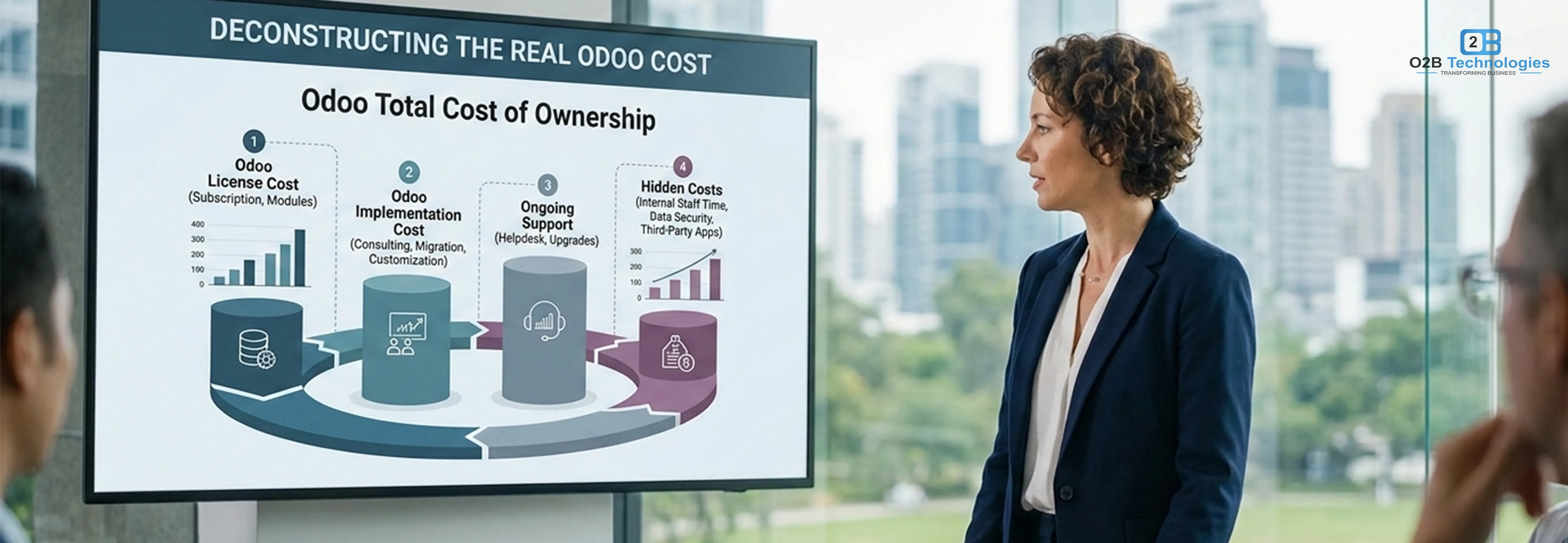
When businesses start evaluating ERP systems, one of the first and most important questions they ask is, 'What is the real Odoo cost?'
At first glance, Odoo pricing may seem simple, especially compared to traditional ERP systems. But the true investments go beyond subscription fees. To make an informed decision, companies must consider the Odoo license cost, the Odoo implementation cost, ongoing support, and all the often-overlooked hidden costs of Odoo ERP.
In this guide, we break down everything you need to know to understand the complete Odoo total cost of ownership.
Coming from QuickBooks? See our QuickBooks to Odoo migration options.
Odoo license prices in 2026
| Plan | Price per user per month | What you get |
|---|---|---|
| One App Free | $0 | One app, unlimited users, hosted on Odoo Online |
| Standard | $24.90 per month with annual billing during the initial 12-month discount; $31.10 monthly list price | All apps, hosted on Odoo Online |
| Custom | $49 per month with annual billing during the initial 12-month discount; $61 monthly list price | All apps, Studio, multi-company, external API, Odoo.sh or on-premise hosting |
| Community | Free, self-hosted | Open-source apps; hosting and support are separate costs |
Prices as of October 2026. Annual-billing discounts are valid for 12 months for the initial users ordered. Check the Odoo pricing page for current rates and terms.
The foundation of Odoo also starts with licensing. Odoo offers two primary editions:
Odoo Community (free version)
- Open source and free to download
- Includes core business applications
- Limited advanced features
- No official enterprise support
Odoo Enterprise (paid version)
Most growing businesses opt for Enterprise because it also includes:
- Full accounting features
- Manufacturing and MRP
- Studio (custom app builder)
- Advanced reporting
- Official upgrades and support
The Odoo license cost is typically calculated per user per month. The total subscriptions depend on:
- Number of users
- Number of applications or modules activated
- Hosting choice (Odoo Online, Odoo.sh, or on-premise)
For example, a 10-user company using sales, CRM, inventory, and accounting will pay significantly less than a 50-user manufacturing company using 15+ modules.
Licensing is also very predictable and even scalable, but it's only a piece of the puzzle.
The real investment: Odoo implementation cost
If licensing is the visible expense, implementation is where most of your ERP budget is invested. Learn about Odoo implementation services.
Odoo implementation cost includes everything required to configure the system according to your business processes. This typically involves:
- Business process analysis
- System configuration
- Data migration from legacy systems
- Customization and development
- Integration with third-party software
- User training
- Testing and go-live support
Cost areas: the quick checklist
- License — the per-user subscription; Community is free, Enterprise plans are paid (current prices on odoo.com/pricing).
- Setup and configuration — mapping your workflows, roles and settings onto Odoo.
- Customization — building only the features that set you apart.
- Data migration — cleaning and moving data from your legacy systems.
- Integrations — connecting shipping, payments, eCommerce and other tools.
- Training — preparing your users before go-live.
- Ongoing support — fixes, upgrades and help after launch.
The cost can vary significantly depending on complexity.
A small business with straightforward workflows may also require minimal configuration. In contrast, a manufacturing company with multiple warehouses, automation rules, and integrations will require more development effort.
Implementation costs vary with the scope, data migration, custom development, integrations and training included in the project. Ask for a written scope and estimate before work starts.
The more complex your operations, the more strategic planning is required to avoid cost overruns.
Looking beyond year one: the Odoo total cost of ownership
Many companies underestimate ERP expenses because they focus only on the initial quote. But ERP systems are also long-term infrastructure investments.
The Odoo total cost of ownership should be evaluated across at least 3 to 5 years.
Year one: setup & deployment phase
This is typically the highest investment year. It also includes:
- Annual subscription fees
- Full implementation services
- Initial hosting setup
- Training and onboarding
- Data migration efforts
This phase lays the foundations for system performance and all kinds of user adoption.
Year two: optimization phase
After go-live, businesses often refine workflows. During this period, costs usually include:
- License renewals
- Minor feature enhancements
- Ongoing technical support
- Performance improvements
- Training for new employees
This is also when many companies discover additional reporting or even automation needs, adding to the hidden costs of Odoo ERP.
Year three and beyond: growth & scaling
As your company grows, so does your ERP footprint. Expansion-related costs may include:
- Adding new users
- Activating new modules
- Multi-company or multi-location setups
- Advanced customizations
- Integrations with new software
Understanding this long-term trajectory is essential when estimating the real Odoo cost.
The hidden costs of Odoo ERP
While Odoo is known for its flexibility and affordability compared to traditional ERP systems, there are potential hidden expenses businesses should plan for.
Customization creep
Excessive customization can increase both development and future upgrade costs.
Integration complexity
Connecting Odoo to e-commerce platforms, payment gateways, or logistics systems may also require additional development hours. Learn more about Odoo integrations.
Data preparation
Poor-quality legacy data can significantly increase migration times and costs. See our Odoo data migration service and data migration mistakes guide.
Change management
If users resist the system's additional training, process refinement may be very necessary. These are not flaws in Odoo; they are common ERP realities. Proper planning reduces these risks significantly.

What affects your Odoo implementation cost?
There is no single implementation price for every business. The total depends on user count, workflows, data migration, integrations, training and the amount of custom development. A defined scope makes estimates easier to compare.
How to lower your Odoo implementation cost
- Plan first: agree on apps, users and must-have features before work starts.
- Use standard Odoo where you can; customize only what sets you apart. See our guide on standard Odoo vs customization.
- Pick a partner who has done projects like yours. Here's how to choose an Odoo implementation partner.
- Go live in phases, starting with the apps you need most.
- Clean your data before migration.
Strategic planning can significantly reduce unnecessary expenses while maximizing ROI.
Our verdict
Our verdict: For most US small and midsize businesses, the Odoo license is the smallest part of the bill. Setup, data migration and any custom work cost more in year one. Start with standard apps, move only the data you need, and get a fixed scope in writing, and Odoo usually costs less over three years than NetSuite or SAP.
Want a number for your business? O2B Technologies can give you an Odoo cost estimate based on your users, apps and data.
Odoo cost FAQs
Is Odoo free?
Odoo Community is free and self-hosted. Odoo Online also has a One App Free plan for one app and unlimited users. Standard and Custom include all apps and have per-user subscription prices.
What's the difference between Standard and Custom?
Standard includes all apps on Odoo Online. Custom adds Odoo Studio, multi-company support, external API access, and the option to use Odoo.sh or on-premise hosting. Odoo.sh hosting may add a separate cost.
How much does Odoo implementation cost?
There is no universal implementation range. Costs depend on the size and complexity of the project, including configuration, data migration, integrations, custom work and training. Ask for a written estimate tied to a clear scope; it should separate one-time implementation work from recurring license and hosting costs.
Is Odoo cheaper than QuickBooks or NetSuite?
It depends on the plans and services you compare. Odoo's One App Free plan has no license fee, while paid Odoo plans and implementation add costs. Compare the apps, users, migration, support and hosting in your own scope against current QuickBooks and NetSuite offers.