Odoo vs NetSuite: Which ERP Is Right for Your US Business in 2026?
When your business outgrows spreadsheets and even all the disconnected systems,choosing the right ERP becomes critical. Over the past year, we’ve guided more than 30+ companies through these exact decisions. What I hear most often isn’t “which system has better features?” it’s “which one will actually work for my business and budget?”
This guide draws from real implementations we’ve completed,including the mistakes we’ve learned from. If you’re evaluating the odoo vs oracle netsuite decision with a budget between rs 2 lakhs ($2400) and rs 50 lakhs ($60,000),this comparison will help you understand what to expect from both platforms.
Why does this comparison exist?
Most ERP comparison articles list features side-by-side without context. That's not particularly helpful when you’re trying to decide whether to invest rs 5 lakhs or 40 lakhs in a system your team will use for the next decade.
At O2B technologies, we’re odoo official partner who has implemented systems across manufacturing,healthcare,media and education sectors. This article reflects what we’ve learned from 50+ implementations, including all the three cases where clients migrated away from their original ERP choice.
We also specialize in odoo implementations, which naturally influences our perspective. However , we’ve also worked alongside netsuite consultants on all kinds of integration projects,giving us insight into both ecosystems.
Understanding what you’re actually comparing
Odoo: The modular approach
Odoo started as an open-source project and evolved into a comprehensive ERP platform. Think of it as building blocks. You choose which modules to even implement and can add more as your business grows.
The platforms comes in the two versions:
Community edition: free and open-source with core functionality
Enterprise edition: paid version with all kinds of advanced features,mobile apps and official support.
Real world example: one of our manufacturing distribution clients started with just sales and inventory modules ($3,360 implementation). Six months later they added purchase and manufacturing (additional $1,440). This phased approach lets them spread costs while learning the system.
Oracle Netsuite: the enterprise suite
Netsuite is Oracle's cloud based ERP designed primarily for mid to large enterprises. Unlike the odoo’s modular approach, netsuite sells an integrated suite with most functionality included from day one.
The platforms targets businesses that:
- Have complex multi-entity structures
- Operate across multiple countries
- Need advanced financial consolidation
- Can budget ($24,ooo) annually for all the licensing alone.
Important distinction: Netsuite isn't necessarily “better” than odoo. It’s designed for different business scenarios and budgets.
The cost reality: beyond the sticker price
Odoo Pricing
Odoo offers 2 editions built for different team structures and technical needs:
- Community Edition: Free, open source, self-hosted. No license fee, but requires in-house or partner-managed hosting and customization work.
- Enterprise Edition: Starts at $24.90 per user/month, billed annually, for Odoo Online. Odoo.sh (cloud with developer access) and self-hosting carry different rates.
A 20-user company typically pays $6,000-$9,000 per year in Enterprise license fees, before implementation. That makes Odoo the lowest-cost entry point in this comparison by a wide margin.
Odoo vs NetSuite Pricing
NetSuite doesn’t publish list prices publicly. Based on reported customer data and NetSuite’s own sales structure, mid-market deployments typically start at $36,000 to $50,000 per year for the base license plus user fees. A 20-user deployment with advanced financials and inventory modules can reach $80,000-$120,000 annually.
Quick Cost Snapshot
| platform | License Model | 20-User Annual Cost (Est.) |
|---|---|---|
| Odoo Enterprise | Subscription | $6,000-$9,000 |
| Oracle NetSuite | Subscription | $80,000-$120,000 |
Lower license costs don’t guarantee a lower total cost of ownership. Odoo implementations require more partner-led customization. NetSuite charges for nearly every add-on module beyond the base platform.
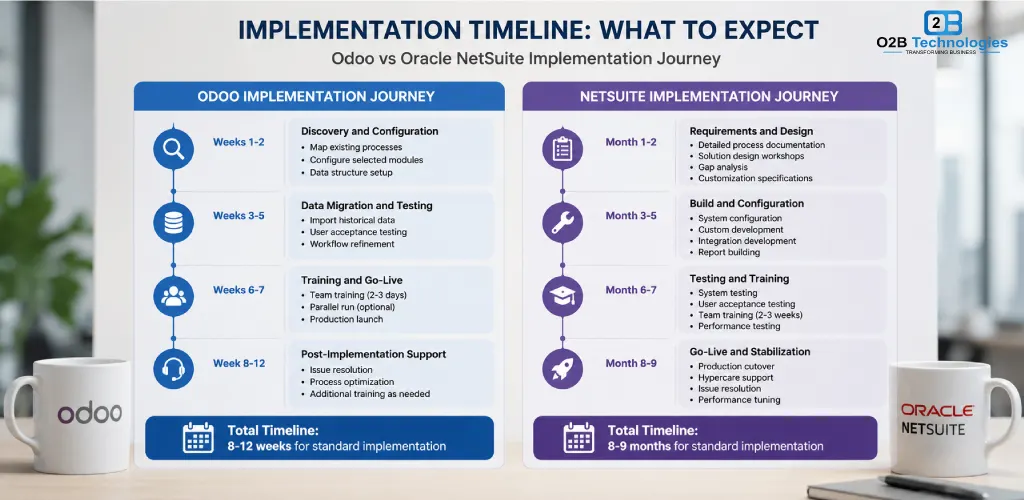
Implementation Timeline: What to Expect
One of the most striking differences in the Odoo vs Oracle NetSuite comparison is implementation speed. This isn’t just about convenience; faster implementation means quicker ROI and less disruption to your business operations.
Odoo Implementation Journey
Weeks 1-2: Discovery and Configuration
- Map existing processes
- Configure selected modules
- Data structure setup
Weeks 3-5: Data Migration and Testing
- Import historical data
- User acceptance testing
- Workflow refinement
Weeks 6-7: Training and Go-Live
- Team training (2-3 days)
- Parallel run (optional)
- Production launch
Week 8-12: Post-Implementation Support
- Issue resolution
- Process optimization
- Additional training as needed
Total Timeline: 8-12 weeks for standard implementation
NetSuite Implementation Journey
Month 1-2: Requirements and Design
- Detailed process documentation
- Solution design workshops
- Gap analysis
- Customization specifications
Month 3-5: Build and Configuration
- System configuration
- Custom development
- Integration development
- Report building
Month 6-7: Testing and Training
- System testing
- User acceptance testing
- Team training (2-3 weeks)
- Performance testing
Month 8-9: Go-Live and Stabilization
- Production cutover
- Hypercare support
- Issue resolution
- Performance tuning
Total Timeline: 8-9 months for standard implementation
Why the Difference?
NetSuite’s longer timeline isn’t inefficient. It’s complex. The system requires:
- More detailed upfront planning
- Specialized consultant expertise (₹15,000-25,000 / $180-$300 per day)
- More extensive testing due to integrated nature
- More comprehensive training due to feature depth
Making the Decision: A Framework
Based on dozens of implementations, here’s how we guide clients through this choice. The Odoo vs Oracle NetSuite decision ultimately comes down to five key factors: budget, timeline, complexity, team readiness, and growth trajectory.
Choose Odoo If:
- Budget: ($2,400-$12,000) for initial implementation
- Timeline: Need to go live within 2-3 months
- Processes: Relatively standard with some customization needs
- Team: Willing to learn new software and adapt processes
- Growth: Moderate growth with ability to add modules later
- Location: Value local support and region-specific expertise
Choose NetSuite If:
- Budget: ($24,000+) available for Year 1
- Timeline: Can accommodate 6-9 month implementation
- Processes: Complex, multi-entity operations requiring consolidation
- Team: Has experience with enterprise software
- Growth: Rapid international expansion planned
- Location: Operating across multiple countries with complex tax requirements
Warning Signs: When Neither Might Be Right
- If your processes are extremely unusual: Consider industry-specific solutions
- If you have under 5 employees: Both systems might be overkill
- If you lack internal IT knowledge: Factor in managed services costs
- If your business model is still evolving rapidly: Wait until processes stabilize
Real Implementation Lessons: Insights from O2B Technologies
Success Story: Discrete Manufacturing Enterprise
- The Challenge: Manual order management and disjointed shop-floor communication caused a 12% error rate and inventory chaos.
- The O2B Solution: We executed a streamlined Odoo deployment covering Sales, Inventory, Purchase, and Manufacturing (MRP) modules.
- Timeline: 8 weeks from kickoff to Go-Live.
- Total Investment: $5,040.
- 6-Month Results:
- Monthly order volume tripled from 300 to 900+.
- The error rate plummeted from 12% to 1.5%.
- Inventory accuracy jumped from 72% to 98%.
- Order fulfillment time dropped by 40%.
- Customer complaints decreased by 67%.
- ROI: Achieved positive return in 7 months through reduced operational errors and automated stock management.
- Key Takeaway: Success came from sticking to core business processes first. Our team helped them resist the temptation to over-customize upfront.
Cautionary Tale: Premature NetSuite Adoption
- The Challenge: A 40-person services firm insisted on adopting a heavy enterprise ERP platform like NetSuite.
- The Mistake: They proceeded with NetSuite despite a $60,000 budget that was far too thin for enterprise-level overhead.
- The Outcome:
- Exhausted 100% of their budget at the 70% implementation mark.
- Took 14 months to go live instead of the projected 6 months.
- Required an extra $30,000 to reach functional completion.
- Their team struggled with steep system complexity for the entire first year.
- Current Status: While the system functions today, the rocky start damaged team confidence and delayed ROI by 18 months.
- Key Takeaway: Budget constraints matter. They would have been significantly better served by deploying Odoo with O2B Technologies initially, with an option to evaluate higher-overhead systems after 3 to 4 years of growth.
Frequently Asked Questions from Our Clients
Can Odoo really handle high order volumes?
Yes, with the right system architecture. O2B Technologies manages client deployments, such as pharmaceutical distributors, processing 15,000+ orders monthly on Odoo without performance lag. The formula comes down to server sizing, routine database maintenance, and efficient workflow engineering. (Note: For companies handling 100,000+ orders daily with highly complex routing, specialized database optimization is required.)
Is NetSuite overkill for mid-sized businesses?
Not always, but budget is the deciding factor. If your business has an annual software budget exceeding $24,000+ (₹20+ lakhs), complex multi-entity structures, and international subsidiaries, NetSuite can work. However, the majority of growing mid-market companies do not need that level of financial overhead.
Can we start with Odoo and migrate later?
Yes. Several clients we advise take a phased long-term roadmap:
- Deploy Odoo for immediate flexibility and rapid ROI (Years 1–3).
- Expand operational complexity and revenue.
- Evaluate enterprise migration only if structural needs dictate it (Years 4–5).
What hidden costs should we budget for?
- Odoo: Server hosting ($180–$600 / ₹15,000–₹50,000 annually if self-hosted), third-party connectors ($300–$1,200 / ₹25,000–₹1,00,000 each), and custom engineering ($1,200–$6,000 / ₹1–₹5 lakhs).
- NetSuite: Integration add-ons ($2,400–$12,000 / ₹2–₹10 lakhs each), major customizations ($6,000–$24,000 / ₹5–₹20 lakhs), SuiteScript development rates ($180–$300 / ₹15,000–₹25,000 daily), and potential peak-usage tier upgrades.
Our Recommendation
For 90% of the growing businesses we counsel, Odoo is the right strategic fit. It directly aligns with:
- Practical budget expectations ($2,400–$12,000 / ₹2–₹10 lakhs implementation range).
- Fast implementation cycles (2 to 3 months).
- Need for clean, modular customizations.
- Direct, responsive support in your time zone.
Get Guidance from O2B Technologies
At O2B Technologies, we have deployed Odoo environments across manufacturing, retail, healthcare, supply chain, and professional services. We understand operational bottlenecks, US and regional compliance, and strict budget constraints.
What We Offer:
- A discovery consultation to map your operational requirements.
- Transparent, line-item pricing with zero hidden fees.
- A customized, phased implementation roadmap.
- Live system demonstrations tailored to your workflows.
Contact O2B Technologies today to speak directly with a certified Odoo architect.