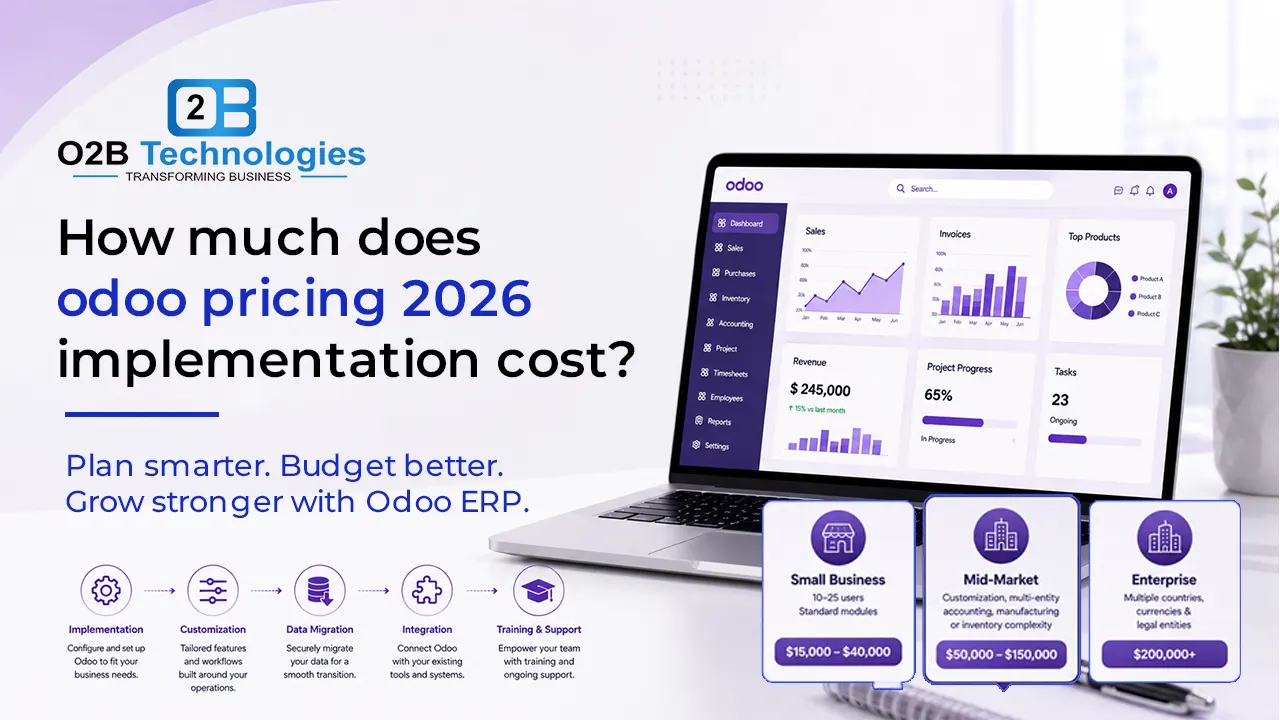
Odoo ERP Implementation Cost in 2026: What US Businesses Should Budget For
Odoo has become a go-to ERP for mid-market and enterprise teams that want big-ERP functionality without a big-ERP invoice. Yet the first question every US leader asks is the hardest to answer from a price list: what will an Odoo ERP implementation actually cost us?
The honest answer is that no two implementations cost the same. Your budget is shaped by what you need the system to do, the shape your data is in, and how many tools Odoo has to talk to. This guide breaks down where Odoo implementation cost really comes from, how long a rollout takes, and how to plan a budget you can defend in front of your board.
What is an odoo ERP implementation?
An Odoo ERP implementation is the structured process of configuring, customizing, migrating data into, and deploying Odoo's business applications. It brings sales, CRM, inventory, accounting, manufacturing, and HR into one connected system instead of a dozen disconnected tools.
In practice, it is a business re-engineering project that uses software as the delivery mechanism. That distinction matters, because it is exactly where in-house IT teams underestimate scope. Activating Odoo takes an afternoon. Implementing it properly, with clean data, trained users, and workflows mapped to how you actually operate, takes a partner who has done it many times before.
Why Are US B2B Leaders Moving Faster on ERP in 2026?
Odoo is now used by millions of people in more than 120 countries. Its open, modular architecture is why manufacturing, distribution, logistics, retail, and professional-services companies keep choosing it over rigid legacy platforms.
For US businesses specifically, three pressures are pushing ERP up the priority list:
- Growth is outpacing spreadsheets. Multi-state sales tax, more SKUs, and more locations expose the limits of disconnected tools.
- Investors and acquirers expect clean systems. Fragmented finance and inventory data slows due diligence and fundraising.
- Legacy platforms are aging out. Teams on QuickBooks, older Sage versions, or on-premise systems face rising maintenance and upgrade costs.
Which leads every leadership team to the same two questions: how do we implement Odoo, and what should we budget for it?
How to Implement Odoo ERP: The Phases That Shape Your Budget
Every phase below carries its own share of the budget. What separates an experienced partner like O2B Technologies from a risky one is how honestly each phase is scoped before the contract is signed.
- Requirement gathering: Our Odoo specialists meet with your stakeholders to document critical business requirements, department by department.
- GAP analysis: We compare your current processes with standard Odoo and identify where workflows need to change, and where Odoo needs to adapt.
- Feasibility study: We confirm what can be handled through configuration and what genuinely requires customization. This step protects you from paying for custom code you don't need.
- Cost and time estimation: With scope defined, we produce a phase-by-phase estimate of effort, timeline, and investment, before any build work begins.
- Development and customization: Our developers configure standard modules and build any custom features or apps your operations require.
- Data migration: Customer, vendor, product, inventory, and financial data is cleansed, mapped, and imported from your legacy systems.
- Go-live and support: Our QA team tests every workflow, then your users validate the system against real scenarios.
- Project Delivery: We deploy to production, train your teams, and provide hypercare support while the system stabilizes.
What Makes Up Odoo ERP Implementation Cost in 2026?
Odoo implementation cost is not a single line item. It is the sum of several components, and the weight of each one depends entirely on your business. That is why we don't publish a flat price: a figure that fits one company would mislead the next.
When you build your budget, plan for these components:
| Cost component | What it covers | What makes it go up |
|---|---|---|
| Odoo licensing | Edition (Community or Enterprise) and user subscriptions | More users, more apps, Enterprise-only features |
| Discovery and solution design | Requirement workshops, gap analysis, process mapping | Many departments, entities, or undocumented processes |
| Configuration | Setting up standard modules, workflows, and access rights | Number of modules and approval layers |
| Custom development | New features, reports, and apps beyond standard Odoo | Unique workflows that configuration can't handle |
| Data migration | Extracting, cleansing, mapping, and importing legacy data | Data volume, years of history, poor data quality |
| Integrations | Payment gateways, e-commerce, 3PL and logistics APIs, tax engines | Number of systems and real-time sync needs |
| Localization and compliance | Multi-state sales tax, multi-currency, multi-entity accounting | Each additional legal entity, state, or country |
| Training and change management | Role-based training and user adoption support | Number of users, sites, and shifts |
| Hosting and infrastructure | Odoo.sh, dedicated cloud, or on-premise servers | Concurrency, performance, and data residency needs |
| Post-go-live support | Hypercare, SLAs, and ongoing optimization | Support hours and response-time commitments |
The most reliable estimate comes from a scoped discovery, not a per-user rate. A proper Odoo implementation cost calculation looks at your actual workflows, data, and integrations. That is why generic online estimates rarely hold up once a real project begins.
How Odoo Implementation Cost Changes With Business Size
Company size is a useful starting point, but complexity moves your budget more than headcount does. Here is what typically drives cost at each level:
| Implementation type | Typical profile | Main cost drivers |
|---|---|---|
| Small business | 10–25 users, standard modules, one entity | Mostly configuration, light data migration, user training |
| Mid-market | Multiple departments, manufacturing or complex inventory, some customization | Custom development, data migration volume, integrations, multi-entity accounting |
| Enterprise | Multiple countries, currencies, and legal entities | Localization per entity, advanced customization, many integrations, scale and performance |
Two companies of the same size can need very different budgets. A 50-user distributor with clean data and one warehouse will spend far less than a 50-user manufacturer with three plants, custom routing, and ten years of legacy data. The only way to know your number is to scope it.
How Long Does an Odoo Implementation Take?
Timeline and cost move together: the longer a project runs, the more it costs. Typical timelines look like this:
| Implementation scope | Typical timeline |
|---|---|
| Small business / basic setup | 1–3 months |
| Mid-sized business | 3–6 months |
| Large enterprise / complex integrations | 6–12+ months |
Your timeline depends on the number of modules, the depth of customization, data migration, integrations, user count, and overall business complexity. A phased rollout, where core modules go live first, often shortens time to value even on larger projects.
What Delaying Your Odoo ERP Implementation Actually Costs
When leaders compare ERP budgets, they often forget the cost of doing nothing. That cost never appears on an implementation invoice, but it shows up every month:
- Finance time lost to manual work: Reconciling disconnected finance and inventory tools can eat 15–20 hours of finance time every month.
- Excess inventory: Spreadsheet-based inventory commonly carries 5–10% more stock than needed, because no one trusts the numbers enough to run leaner safety stock.
- Slower deals: Fragmented systems raise due-diligence flags in acquisitions and can slow investment rounds.
- Stalled expansion: New locations and franchise growth suffer when systems don't connect.
None of that appears on an implementation quote. All of it appears on next year's P&L.
Choosing the Right Odoo ERP Implementation Partner
Here is what rarely makes it into a sales pitch: your outcome, and your final cost, depend more on the partner you choose than on the software. Odoo is excellent technology. It is also easy to implement badly, and rework is the most expensive line in any ERP budget.
When you assess an Odoo implementation partner, look past the logo wall and check three things:
- 1. Proven experience in your industry
- 2. A documented data migration methodology
- 3. Post-go-live support commitments in writing, not verbal promises
Regional expertise matters more than most buyers expect. O2B Technologies brings local compliance knowledge to every market we serve:
- United States: Headquartered in the USA, we deliver expertise in multi-state sales tax compliance (including Avalara integrations), 1099 reporting, state-specific payroll structures, and PE-driven M&A readiness.
- United Kingdom: Our specialists handle Making Tax Digital (MTD) requirements, HMRC-compliant e-invoicing, and complex UK VAT rules.
- UAE and the Middle East: We bring hands-on experience with regional VAT compliance, Arabic-English bilingual invoicing, and free-zone regulations.
- Australia: We configure for GST rules, Single Touch Payroll (STP Phase 2), and state-based compliance from day one.
Certified Quality and Verified Expertise
A fast-growing precision equipment distributor with 180 employees across the US and Europe came to us after a 12-month ERP deployment with a generalist provider went wrong. Stock levels were out of sync across fulfillment hubs, month-end close took over two weeks of manual reconciliation, and leadership had lost confidence in its data.
O2B Technologies restructured the rollout:
- Rigorous scoping: 10 days of workflow discovery, auditing every supply chain, assembly, and financial handoff before configuration.
- Phased deployment: Phase 1 covered US warehouse management and finance; Phase 2 added multi-currency, EU-tax-compliant sales and invoicing.
- Custom workflow engineering: Our senior developers built Make-to-Order (MTO) assembly logic and serial-number tracking the previous vendor couldn't deliver.
- Staged data validation: Historical data migration ran alongside User Acceptance Testing (UAT), so anomalies were fixed in the sandbox.
The impact: The company went live across both territories within 8 weeks, reached 99.4% inventory tracking accuracy, and saw near-complete user adoption in the first three weeks. Monthly financial close dropped from 14 days to 2.
The lesson for budgeting: the cost of a failed implementation, plus the cost of fixing it, is almost always higher than the cost of scoping it properly the first time.
15 Best Practices to Keep Your Odoo Implementation on Budget
Our implementation framework is built to control cost and risk at every stage:
- 1. Standardize processes before customizing: Define core workflows at the enterprise level first to avoid unnecessary custom code.
- 2. Map tax, accounting, and compliance early: Identify US multi-state sales tax, Avalara syncs, VAT, MTD, and local reporting needs upfront.
- 3. Design multi-company and multi-currency structures first: Set your chart of accounts, inter-company rules, and consolidation reporting before configuration.
- 4. Assign data owners before migration: Name department leads who verify and approve legacy data before extraction.
- 5. Cleanse and de-duplicate master data: Scrub customers, vendors, accounts, and SKUs before import.
- 6. Test integrations with real scenarios: Stress-test 3PL, e-commerce, and payment connections with real order volumes and edge cases.
- 7. Keep customizations upgrade-safe: Build modular custom features so future Odoo version upgrades stay simple.
- 8. Match hosting to your needs: Choose Odoo.sh, dedicated cloud, or on-premise based on load, performance, and data residency.
- 9. Plan rollback and contingency: Keep tested rollback procedures and automated backups ready before every major release.
- 10. Train power users with real workflows: Use role-based simulations of daily tasks instead of generic demos.
- 11. Audit localization settings in a sandbox: Verify tax schedules, currency feeds, bank reconciliation rules, and fiscal calendars before launch.
- 12. Lock in post-go-live support early: Agree on hypercare and SLAs well before launch day.
- 13. Measure adoption, not just go-live: Track logins, process completion, and transaction speed.
- 14. Audit custom modules before upgrades: Review custom code, connectors, and Studio automations before major version updates.
- 15. Run full end-to-end UAT: Test the complete flow, from lead and sales order through fulfillment, manufacturing, and financial reconciliation, before production launch.
Get a Realistic Odoo Implementation Estimate for Your Business
For more than a decade, O2B Technologies has delivered phased, compliance-aware, certified-developer-led Odoo implementations across the USA, UK, UAE, the wider Middle East, and Australia.
Your next step is a discovery call with an Odoo expert, not another generic pitch deck. Bring your current bottlenecks, such as inventory mismatches, slow month-end close, or multi-entity tax challenges. We'll map them to a phased implementation plan and give you a cost and timeline estimate based on your actual scope, before you sign anything.
Talk to O2B Technologies before you finalize your ERP budget, not after your first rollout stalls.
Frequently Asked Questions
1. What is Odoo ERP implementation?
Odoo ERP implementation is the process of configuring, customizing, migrating data, integrating systems, training users, and deploying Odoo across an organization. It connects sales, CRM, inventory, accounting, manufacturing, and HR in one system.
2. How much does an Odoo ERP implementation cost in 2026?
There is no fixed price, because cost depends on your users, modules, customization, data migration, integrations, and number of legal entities. The most accurate way to budget is a scoped discovery with an experienced Odoo partner, which produces a phase-by-phase estimate for your business.
3. What factors affect Odoo implementation cost?
The biggest factors are the depth of custom development, data migration volume and quality, third-party integrations (payments, e-commerce, logistics APIs, tax engines), the number of users, and the number of localized entities.
4. How long does an Odoo ERP implementation take?
A basic small-business implementation typically takes 1–3 months, a mid-sized implementation 3–6 months, and a large enterprise rollout with complex integrations 6–12+ months.
5. How can I keep my Odoo implementation within budget?
Scope thoroughly before development, standardize processes before customizing, clean your data before migration, and choose a certified partner with industry experience and written post-go-live support commitments.