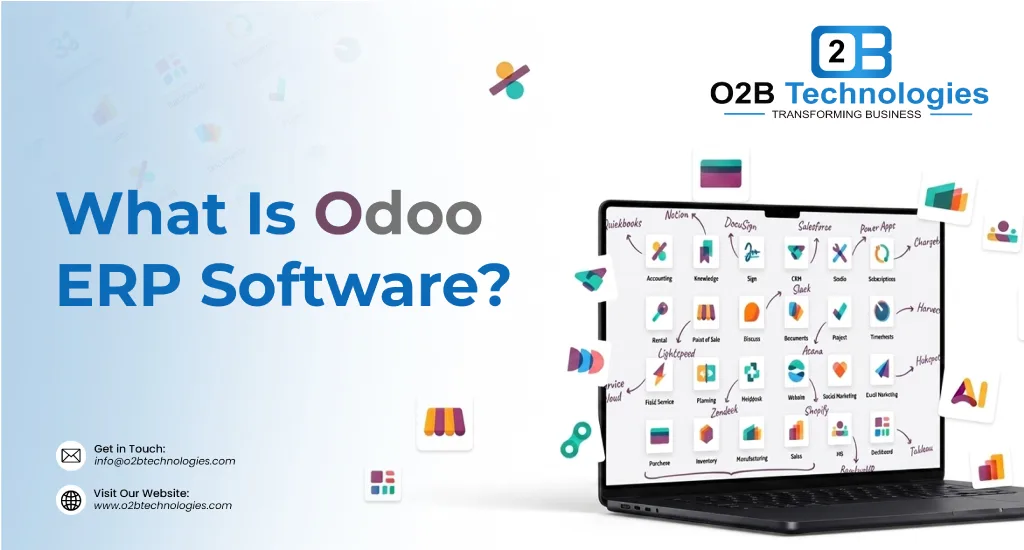
What Is Odoo ERP Software? A Complete Guide for US Businesses (2026)
If you have ever found yourself toggling between a separate accounting tool, a standalone CRM, and three different Excel trackers-each demanding separate logins and throwing off its own monthly bill-you already understand the exact friction Odoo was built to solve.
Odoo is an open-source, all-in-one business management platform that replaces piles of disconnected software with a single unified system. Originally launched in 2005 as Tiny ERP, it was renamed OpenERP in 2009 and officially became Odoo in 2014-a name reflecting its broader ambition beyond traditional enterprise resource planning. Today, it is used by millions of businesses across more than 100 countries, backed by a large, active global developer community.
The underlying code is publicly available, protecting businesses from traditional vendor lock-in. The platform operates modularly, allowing companies to start with a single app and expand seamlessly. Odoo ERP software is purpose-built for small to mid-sized enterprises (SMEs) that need professional-grade tools without enterprise price tags.
What Is Odoo ERP Used For?
Odoo covers the full operating cycle of a business, from initial sales leads to final customer invoicing. Here is where companies across the world deploy it most consistently
- Accounting and Finance: Features automated invoicing, bank reconciliation, multi-currency profit-and-loss management, and pre-configured tax structures tailored for state-by-state compliance.
- Sales and CRM: Includes pipeline management, lead scoring, automated follow-ups, interactive quotation builders, and integrated e-signatures.
- Inventory and Warehouse: Provides multi-location stock visibility, barcode scanning, Make-to-Order (MTO) and Make-to-Stock (MTS) reorder rules, and serial number traceability for export and regulatory compliance.
- Manufacturing (MRP): Manages Multi-Level Bills of Materials (BOMs), work
orders, real-time shop floor monitoring, and IoT machine data capture. Operators view
real-time instructions on tablets instead of paper travelers, eliminating manual data-entry
errors.
- Advanced Manufacturing Workflows: Beyond standard production, growing manufacturers often encounter edge cases such as "Build/Unbuild" disassemblies, multi-lot traceability, and scrap handling. While Odoo’s native MRP manages standard production runs cleanly, complex multi-stage operations or customized scrap/return workflows typically require tailored logic and custom routing rules to maintain inventory accuracy across shop floors.
- HR and Payroll: Streamlines employee management from recruitment to payroll and attendance. Businesses can easily track employee performance, automate payroll runs, and manage time-off requests within one system.
- E-Commerce and Point of Sale (POS): Odoo E-Commerce allows businesses to build and manage online stores that connect directly with backend operations. Unlike standalone platforms, it syncs natively with live inventory, sales, and accounting data-making it an ideal solution for direct-to-consumer (D2C) brands and retail businesses going omnichannel.
How Does Odoo Work?
Most businesses run separate software for each department, resulting in manual re-entry of data at every handoff-a "copy-paste trap" that wastes time and introduces human error.
Odoo closes that loop with a shared database architecture. Every module-Sales, Inventory, Accounting, Manufacturing, and HR-reads from and writes to the exact same central database in real time.
Odoo 19: The AI Agent Upgrade for 2026
The Odoo 19 release cycle represents the platform’s most significant leap forward in AI integration, embedding intelligent AI agents directly across the core suite to benefit North American businesses:
- CRM & Sales: AI-assisted lead research and automated lead scoring significantly reduce manual qualification work for sales teams.
- Accounting & Finance: Automated bank reconciliation processes high-volume environments efficiently, automatically matching bank feeds against open invoices.
- Inventory & Supply Chain: Predictive reorder algorithms automatically factor in historical lead times and supplier performance-essential for businesses managing thousands of SKUs across multiple vendors.
- Performance: The platform interface has been tuned for speed, catering to high-volume, fast-paced data entry environments.
Key Features of Odoo
Integrated Applications Under One Standard License
A standard subscription gives your business access to the entire core suite of apps for one flat per-user fee, eliminating per-module surcharges common among traditional ERP vendors.
| Category | Core Applications Included |
|---|---|
| Finance | Accounting, Invoicing, Expenses |
| Sales | CRM, Sales, Subscriptions, Sign |
| Operations | Inventory, Manufacturing, Purchase, PLM |
| People | HR, Payroll, Recruitment, Timesheets |
| Marketing | Email Marketing, SMS, Social Marketing |
| Website | eCommerce, Live Chat, Blog |
Open-Source Flexibility, No Vendor Lock-In
Odoo’s codebase is openly accessible. Authorized implementation partners can modify screens, workflows, and reports without waiting on software vendor approval queues. For businesses with complex operational needs, hiring an Odoo expert ensures these specialized integrations are built securely on a clean foundation.
Modular Growth
Businesses can launch with a single module-such as Inventory-and progressively enable Manufacturing, Accounting, or HR as operational requirements scale. However, while adding modules is straightforward, migrating historical accounting records and customer databases from legacy systems (like QuickBooks or NetSuite) requires structured data mapping, cleansing, and professional execution.
Software Licensing vs. Custom Implementation
Understanding how Odoo is structured helps set realistic project expectations:
- Odoo Enterprise License (Software): Grants access to all Odoo Enterprise applications, native cloud hosting (Odoo.sh or Cloud), and standard software updates.
- Customization & Professional Services (Implementation): The software subscription is standard, but specialized operational requirements-such as multi-entity consolidations, third-party API integrations, on-premise hosting setups, or custom workflows built via Odoo Studio-require professional development services rather than software tier upgrades.
Central Hub vs. Full Replacement: Standard or Hybrid Deployment?
While Odoo is fully capable of replacing legacy software like QuickBooks, Salesforce, and Shopify, modern enterprise rollouts often follow a Hybrid Deployment Model.
Rather than executing a risky, all-at-once migration, Odoo can serve as the operational central hub while maintaining external connections to preferred legacy software. Custom API integrations ensure real-time data synchronization across all connected platforms without disrupting day-to-day sales or fulfillment.
Why O2B Technologies Is Your Trusted Odoo Implementation Partner in the USA
Selecting the right Odoo partner is just as critical as choosing the ERP platform itself. Successful enterprise adoption requires technical precision, industry foresight, and continuous operational support. At O2B Technologies, we bridge the gap between complex operational bottlenecks and seamless digital transformation.
- Certified Odoo Partner: Work directly with certified specialists and technical implementers adhering to global deployment standards.
- Experienced Consultant Network: Access a multidisciplinary team of senior Odoo consultants and developers equipped to solve complex architectural and workflow challenges.
- End-to-End Delivery Scope: From initial system scoping and data migration to custom module development and post-launch support, we handle the full project lifecycle.
- Multi-Industry Mastery: Benefit from proven deployment experience across manufacturing, retail, healthcare, supply chain, and professional services.
- Future-Proof Scalability: Deploy system architectures designed to scale effortlessly alongside your business as operational demands grow.
- Long-Term Dedicated Support: We provide continuous post-implementation optimization, upgrades, and support long after go-live to ensure maximum long-term ROI.
Frequently Asked Questions for US Decision-Makers
1. How does O2B Technologies manage project delivery across US time zones?
Our Austin headquarters leads customer-facing strategy, architecture design, and account management. Technical development and execution run on a dual-shore model, providing continuous project progress across Eastern, Central, Mountain, and Pacific time zones.
2. Can Odoo replace our existing software stack, or can we run a hybrid model?
Both. Odoo natively consolidates CRM, accounting, inventory, and e-commerce into a single database. However, if your team prefers to retain specific platforms (such as Shopify or a specialized CRM), O2B designs and builds custom API connectors to keep your external systems synchronized in real time.
3. How long does a standard US Odoo rollout take with O2B?
For mid-market US companies, core implementations typically go live within 8 to 12 weeks. Larger multi-company or complex manufacturing setups generally range from 3 to 6 months, managed with strict milestone tracking to prevent scope creep.
Is Odoo Worth It for Your Enterprise?
Two decades of continuous development have established Odoo as one of the most powerful, flexible ERP platforms for American small and mid-sized businesses. Navigating growth in the US market requires agility, speed, and strict operational control. Odoo eliminates software fragmentation by unifying your operations around a single source of truth.
- US-Specific Financial Compliance: Pre-configured localization handles state-by-state sales tax rules (including seamless Avalara integration), automated 1099 reporting, and native ACH/Stripe payment processing.
- Supply Chain & Logistics Power: Built-in integrations with major US carriers (FedEx, UPS, USPS) and automated 3PL sync streamline fulfillment across domestic fulfillment hubs.
- Shop-Floor & Manufacturing IoT: Manufacturing-grade IoT connectivity pairs factory hardware directly with your ERP, driving real-time inventory precision and automated work orders.
- Maximum ROI & Scalability: Modular architecture allows US enterprises to scale operations, add business units, and expand multi-warehouse networks without incurring prohibitive licensing overhead.
Odoo provides business leaders with an affordable, enterprise-grade foundation designed to scale without bloated operational costs.
Partner with O2B Technologies’ Austin-based team to scope, customize, and deploy your tailored Odoo ecosystem. Contact O2B Technologies today to schedule a 1-on-1 discovery call with an Odoo architect.
Ready to use Odoo in your business? Explore our Odoo ERP software and services.