Odoo Point of Sale for Retail Stores
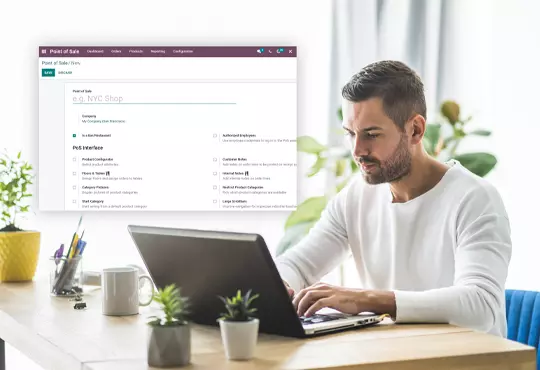
Odoo POS is a Compatible ERP Solution

Odoo online POS application has a very simple and user friendly interface. The user need not have any specific installation and hardware requirement to access the system.

Through this Point of Sale software solution, retail businesses can register in-store customer sales, accept multiple tender types, and manage day-to-day register closings seamlessly. Odoo presents a full-featured Point of Sale app that helps you streamline counter operations. Backed by certified Odoo implementation services, Odoo POS integrates natively with Inventory and Accounting, giving retailers the flexibility to trade both online and offline without data loss.

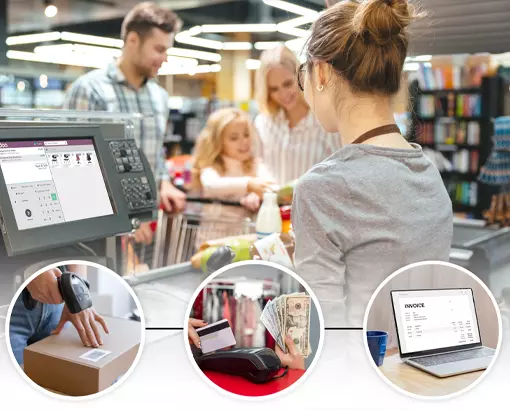
Store associates can access the application across standard desktop computers, touchscreen terminals, iPads, Android tablets, and laptops. To match your retail store workflows, Odoo Point of Sale is fully configurable—allowing custom product grids, fast barcode scanning, automated receipt printing, and rapid payment terminal processing.

O2B Technologies provides end-to-end POS configuration and hardware integration through our certified team of Odoo consultants, ensuring round-the-clock functional support and operational continuity for multi-store retailers.
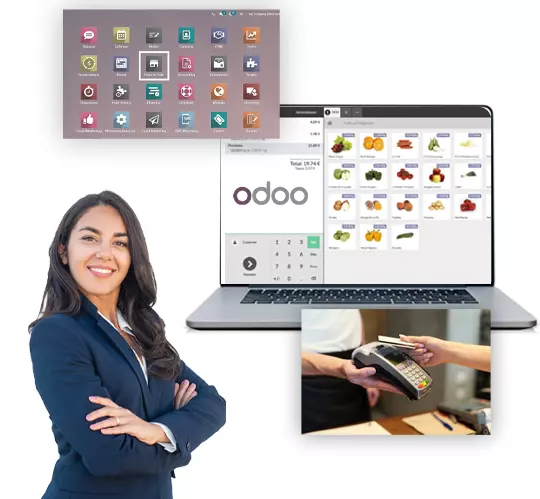
Odoo POS is a Compatible ERP Solution

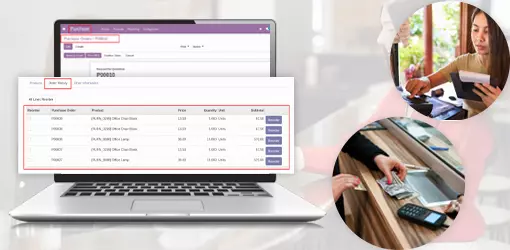
How POS Connects to the Rest of Odoo

A sale completed at the till instantly updates your entire ERP back-office in real time: inventory quantities decrease at the store location, the customer profile records purchase history and reward points, and accounting journal entries post revenue and payment reconciliations simultaneously without manual batch entries.

Features of Odoo Point of Sale

O2B can set up Odoo POS on tablets and touchscreen terminals quickly. Let's explore the key features of Odoo Point of Sale for retail stores:

1. Payments

  • Payment Methods: Cash, checks, and credit card payment methods are available. New types of payment methods can be added as well.
  • Credit/Debit Cards: All electronic payments are handled by external payment terminals.
  • Offline Payments Orders made offline are automatically synchronized when you are reconnected.

2. Checkout

  • Barcode Scanning: Scan products instantly with handheld USB, Bluetooth, or wireless barcode scanners, supporting embedded barcodes for weight, price, and discounts.
  • Electronic Scales: Calculate product weight automatically at the counter with integrated electronic scale hardware for accurate fresh-food and bulk pricing.
  • Quick Product Search: Locate items immediately using real-time search by product name, barcode, internal SKU, or visual category grid.
  • Prices & Discounts: Set customer-specific prices or offer percentage-based discounts on either a single product line or the entire order.
  • Parallel Orders: Put orders on hold and process multiple customer orders simultaneously without losing active cart data.
  • Split Payments: Allow customers to split tender across multiple payment methods (partial cash, card, and vouchers) on a single checkout ticket.
  • Offline Mode: Continue ringing up sales, scanning barcodes, and printing receipts even during internet outages; transactions sync automatically once reconnected.
Checkout
Store Management

3. Store Management

  • Order History: View all past orders as well as search by customer, product, cashier, or date.
  • Daily Sales: Keep track of daily sales and totals for every payment type.
  • Cashier Accounts:Manage multiple cashier accounts and secure them with badges or pin codes.

4. Customer & Loyalty

  • Register & Identify Customers: Identify your customers by simply registering their email and contact address, allowing you to offer discounts and keep track of individual sales. Look up your customers with the built-in search feature or identify them with a barcode printed on their loyalty card.
  • Business Customer: Register your customer's VAT number and apply them to invoices.
  • Loyalty Card: Reward your customers with loyalty points and exchange them for gifts or discounts. Points can be earned by product, by order, or by sale amount.
Customer and Loyalty
Restaurant Management

5. Restaurant Management

  • Floor Plans: Assign orders to tables and receive an overview of your restaurant's floors as well as make changes on the go with the graphical editor. Manage seating and keep track of your guests with an overview of your restaurant's capacity and table availability.
  • Delayed Order:Take orders for different courses of the meal at once with the ability to send them to the kitchen printer at separate times.
  • Split Bills: Let customers pay separately or at different times by splitting orders.

6. Products

  • Product Categories: Organize your products with hierarchical product categories. Order them by popularity and display different categories in different points of sales.
  • Product Search: Quickly find products by their name, barcode, or description with the built-in search function.
  • Units of Measure: Sell your products with custom or preset units of measure and update your stock accordingly.
Products
Web Application

7. Web Application

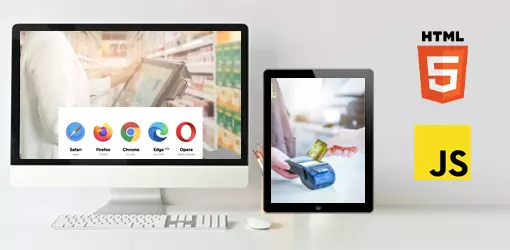
  • Browser Support: Odoo POS is a web-based application and can be deployed on any device and OS running Chrome, Firefox, or Safari. Microsoft Windows, Apple OSX, Linux, Android, and iOS are all supported operating systems.
  • iPad First: Odoo POS is best used on a recent iPad or Android Tablet of comparable size and performance.
  • HTML5 Mods: Odoo POS is Open-Source and can be customized with HTML5/JS extension modules.

The Odoo POS Dashboard

Odoo Point of Sale Dashboard

Odoo point of sale module is smoothly integrated with the remaining modules of Odoo. It will help the user to use the complete retail sales management system.

  • Run multiple sessions at an instance
  • Cash counter management
  • Cashier login
  • Barcode scanners
  • Virtual keyboards
  • Loyalty programs
  • Integrated payment terminals
  • Accept cash and card payments
  • Integrated sales management module
  • Direct invoicing
Industry Example

Electronics & Electrical Retailers: Serial Tracking, Warranties, and Omnichannel Stock

Consumer electronics and electrical goods retailers manage high-value inventory with stringent warranty obligations. Connecting Odoo Point of Sale directly with Odoo Inventory solves their key operational challenges:

Serial Number Tracking at Checkout

When scanning items tracked by unique serial numbers (e.g., smartphones, laptops, power tools), the cashier is immediately prompted to scan or select the serial number before completing the transaction. Each unique unit is recorded on the POS receipt and customer invoice.

Automated Warranty & Repair Links

The recorded serial number links the sale to customer warranty coverage and maintenance histories in Odoo Repair and Helpdesk. Service technicians can verify purchase dates, coverage limits, and service tickets instantly when a customer returns for support.

Real-Time Omnichannel Stock Sync

Store registers and your Odoo eCommerce website share live inventory counts across retail branches and warehouses. In-store purchases automatically decrement available stock online, preventing overselling of fast-moving consumer electronics.

Odoo POS Review: Pros and Cons

An objective assessment of Odoo Point of Sale for retail store operators, franchise managers, and multi-location business owners evaluating an integrated retail solution.

Pros of Odoo POS

  • Runs on Any Browser or Tablet: Deploy on iPad, Android tablets, touch terminals, or standard PCs without specialized operating systems.
  • Reliable Offline Functionality: Continues processing sales, taking payments, and issuing tickets when internet drops, automatically syncing transactions upon reconnecting.
  • Unified Real-Time Sync: Sales immediately deduct stock in Inventory, award customer loyalty points in CRM, and record journal entries directly in Accounting.
  • Multi-Store Centralization: Configure shared product catalogs, prices, and promotions centrally while tracking registers across multiple physical stores.

Cons of Odoo POS

  • Specialty Peripheral Setup: Hardware like ESC/POS thermal receipt printers, electronic weight scales, customer displays, and cash drawers require network configuration or an Odoo IoT Box.
  • Retail vs. Restaurant Differences: Features differ between retail operations (fast barcode scanning, cashier shifts) and hospitality/restaurant setups (table mapping, split bills, kitchen order display).
  • Enterprise Tier Features: Advanced retail capabilities such as multi-company inter-warehouse replenishments and advanced payment terminal integrations may require Odoo Enterprise.

FAQ

1What are the basic requirements for Odoo POS implementation?

Odoo POS operates directly in any modern web browser (Chrome, Firefox, Safari, Edge) on desktop PCs, laptops, iPad, and Android tablets, as well as industrial POS touch terminals. It works fully offline and syncs automatically when reconnected.

2Does Odoo Point of Sale support working offline as well?

Yes, Odoo POS works completely offline. You can continue taking orders and processing transactions even if the internet connection is lost. All transactions are stored locally in the browser and automatically synchronize with your database once connectivity is restored.

3Can Odoo Point of Sale be used on any device?

Odoo POS can also be used on standard computers and tablets as well as industrial touch screen terminals.

4 Can we use printers and scanners with Odoo POS?

Yes, you can. Odoo supports barcode scanners, receipt printers, customer-facing displays, electronic scales, and cash drawers directly via USB, Bluetooth, network, or the Odoo IoT Box.