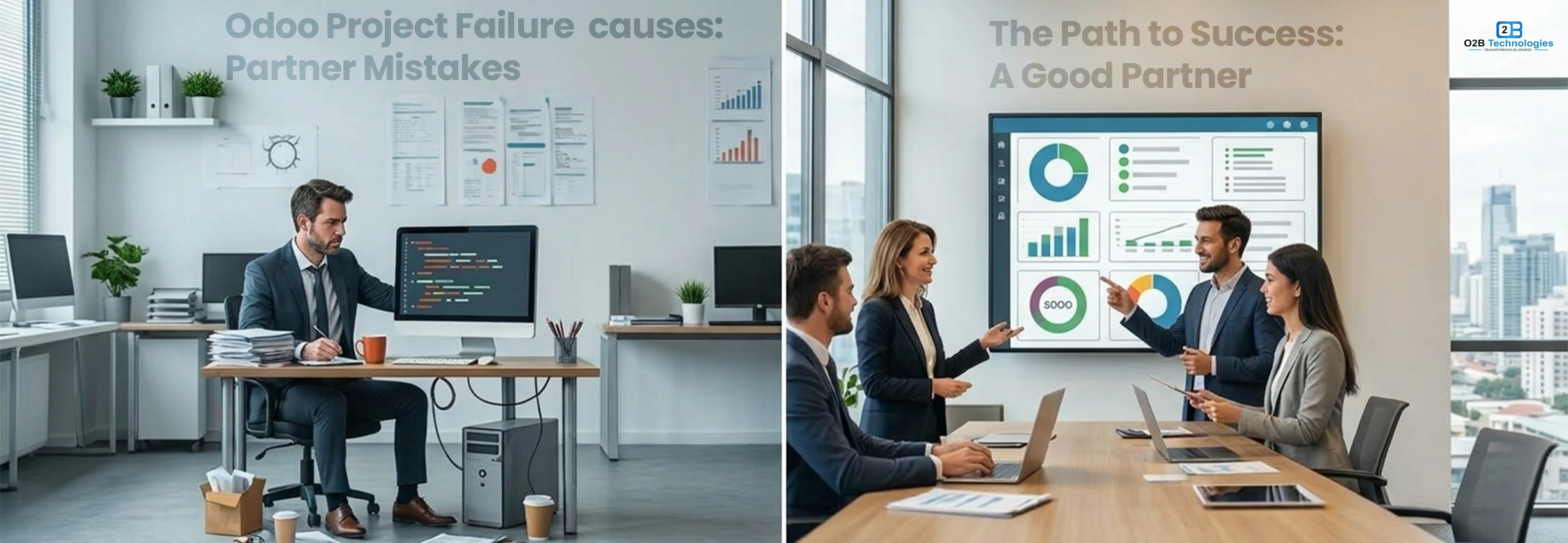
Choosing the right Odoo partner can determine whether your ERP becomes a growth engine—or a daily frustration.
Many companies assume that once they hire an implementation partner, success is
guaranteed.
Unfortunately, that’s not always true. Poor guidance, rushed processes, and weak
strategy can create long-term operational damage.
If you’re experiencing delays, confusion, reporting problems, or user resistance, you may be dealing with serious Odoo partner mistakes.
Let’s break down the warning signs, uncover common Odoo project failure causes, and understand how to evaluate Odoo partner capabilities before more damage is done.
Hiring fresh instead? Ask the 12 questions to ask an Odoo partner before signing first.
1. They Skipped Deep Discovery
A strong implementation starts with business understanding configuration.
If your partner:
- Jumped directly into system setup
- Didn’t map end-to-end workflows
- Avoided department-level workshops
- Failed to document “current vs future state” processes
You’re likely dealing with the wrong Odoo implementation partner. Discovery is not optional. It’s the foundation. Without it, the system may technically function—but operationally fail. This is one of the earliest bad ERP implementation signs.
Looking for Odoo Implementation, Customization, Integration, or Support Services?
2. They Over-Promised and Under-Explained
Another major Odoo consulting red flag indicator is unrealistic promises:
- “Everything is possible.”
- “It’s very simple.”
- “We’ll handle everything—no need for internal involvement.”
ERP projects are complex. They require collaboration, decision-making, and business ownership.
If your partner made it sound effortless without explaining risks, dependencies, or responsibilities, that’s a serious warning sign.
Strong consultants educate clients about complexity. Weak ones oversell simplicity.
3. Excessive Customization from Day One
Customization is sometimes necessary—but if your system was heavily modified before you even went live, that’s concerning.
Excessive customization is one of the most common Odoo project failure causes because it:
- Increases cost
- Complicates upgrades
- Introduces bugs
- Reduces system stability
If your partner never challenged your requests and simply built everything exactly as asked, you may be seeing Odoo partner mistakes in action.
A good partner simplifies processes before customizing them.
4. No Clear Project Governance
ERP requires structure.
If your project lacked:
- Defined milestones
- Weekly review meetings
- Change request documentation
- Budget tracking
- Risk management discussions
You likely chose the wrong Odoo implementation partner.
When timelines slip and scope expands without control, the result is confusion and financial strain.
Poor governance is one of the most visible bad ERP implementation signs.
5. Weak Data Migration Planning
Data migration is critical—yet many partners treat it as a simple import task.
If your go-live included:
- Duplicate records
- Missing opening balances
- Incorrect stock levels
- Broken account mappings
These are serious Odoo partner mistakes.
Improper migration leads to long-term trust issues in the system.
It’s also one of the hidden Odoo project failure causes that becomes visible only after go-live.
6. Limited Training and Adoption Support
Implementation doesn’t end at go-live.
If your partner:
- Conducted only one generic training session
- Didn’t provide role-based guidance
- Offered no post-go-live support
- Blamed users for confusion
You’re facing classic Odoo consulting red flags.
Low adoption is not a user problem—it's an implementation gap.
A strong partner invests in training, documentation, and adoption monitoring.
A weak one disappears after deployment.
7. They Focused on Technical Setup, Not Business Outcomes
ERP is not just about configuring modules.
If your partner never discussed:
- KPIs
- Reporting structure
- Scalability plans
- Future automation
- Business growth alignment
Then the implementation may lack strategic depth. This is one of the more subtle Odoo partner mistakes. Technical deployment without business alignment often leads to operational frustration.
8. Constant Firefighting After Go-Live
If months after launch, you’re still dealing with:
- Frequent bugs
- Reporting inconsistencies
- Integration failures
- Performance slowdowns
- Repeated rework
These are serious bad ERP implementation signs.
While minor adjustments are normal, ongoing instability points to weak architecture or rushed execution. Consistent firefighting usually traces back to poor planning—one of the main causes of Odoo project failures.
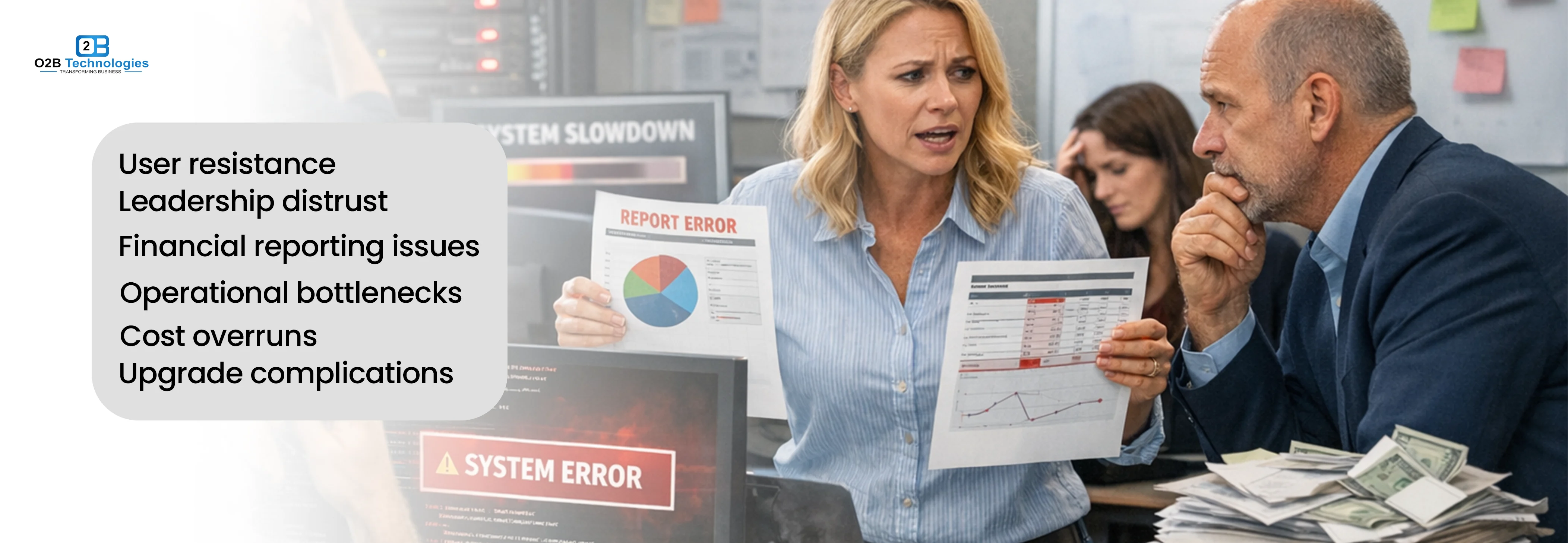
Choosing the wrong Odoo implementation partner doesn’t just delay your project.
It can cause:
- User resistance
- Leadership distrust
- Financial reporting issues
- Operational bottlenecks
- Cost overruns
- Upgrade complications
And worst of all, it may lead management to believe the software itself is flawed. Often, the real issue isn’t Odoo. It’s a poor consulting strategy.
How to Evaluate an Odoo Partner Effectively
If you’re planning a new project—or considering replacing your current partner—here's how to evaluate an Odoo partner properly:
1. Ask About Their Discovery Process
Do they conduct structured workshops?
Do they document workflows before configuring?
2. Review Case Studies
Have they handled businesses of similar size and complexity?
3. Assess Their Customization Philosophy
Do they default to standard workflows first?
4. Evaluate Governance Structure
How do they manage scope, risks, and approvals?
5. Understand Post-Go-Live Support
What happens after deployment?
6. Check Upgrade Strategy
How do they ensure long-term maintainability?
A strategic partner thinks beyond launch day.
When It’s Time to Rethink Your Partner
If you recognize multiple Odoo consulting red flags, it may be time for:
- A system health audit
- A third-party assessment
- Process re-engineering
- Stabilization planning
Recovering from Odoo partner mistakes is possible—but it requires honest evaluation and corrective action. Ignoring the warning signs only increases cost and operational stress.
Final Thoughts
ERP success depends as much on partnership as on technology. If you’re seeing recurring issues, delays, instability, or adoption struggles, the root cause may not be your team—it may be the consulting approach. Understanding these Odoo project failures empowers you to make better decisions moving forward. The right partner simplifies complexity.
The wrong one amplifies it. Choose wisely—because in ERP, strategy matters more than software.