ERP plays a significant role in the oil and gas industry, and the stakes are higher because the sector handles complex projects with real-time traceability. But oil and gas buyers are not all the same, so the right ERP depends on the type of company. This guide compares options for upstream operators, midstream and large producers, and oilfield service companies, equipment suppliers and rental firms. It also covers the challenges the sector commonly faces.
Looking for Odoo Implementation, Customization, Integration, or Support Services?
Which type of oil and gas company are you?
Operators (upstream)
Operators need well and lease accounting, joint interest billing, revenue distribution and production data. Specialist oil and gas systems usually fit best.
Midstream and large producers
These companies need asset management, maintenance and large-scale finance across multiple entities and locations.
Oilfield service companies, equipment suppliers and distributors
These businesses need field service, rentals, inventory, quoting and invoicing. This is where Odoo fits best.
ERP options by company type
These options are used by US oil and gas companies. The right fit depends on the type of company, the accounting requirements and the field workflows involved.
| Software | Best for |
|---|---|
| Odoo | Oilfield service companies, equipment rental firms and suppliers wanting field service, rentals, inventory and accounting in one system |
| Enertia | Upstream operators (oil and gas accounting) |
| Quorum Software | Upstream and midstream operators |
| P2 Energy Solutions | Upstream operators (land, production and accounting) |
| SAP S/4HANA | Large integrated oil and gas companies |
| IFS | Asset-heavy firms needing maintenance and field service |
Odoo

Odoo is an open-source ERP for oilfield service companies, equipment rental firms and suppliers. It combines field service, rentals, inventory, purchasing, sales and accounting in one system, and can be extended with a partner portal or automated workflows. The software also gives benefits like extensive community support, third-party integration and an easy to use interface.

Enertia
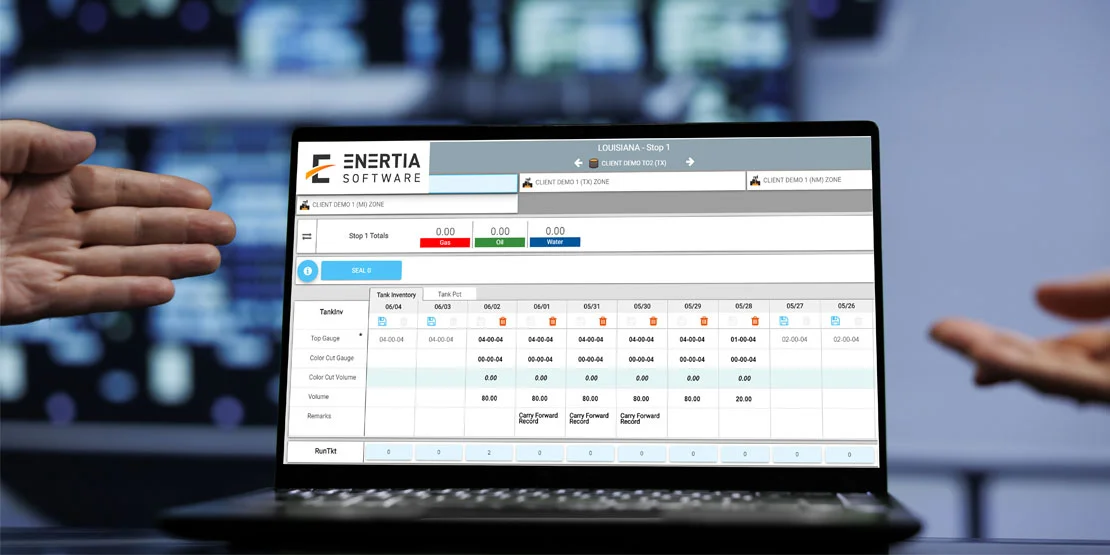
Enertia is an integrated ERP built for oil and gas accounting. It supports land, production and revenue data for upstream operators and runs on-premises. It suits medium and large operators that need dedicated oil and gas accounting.
Quorum Software
Quorum Software serves upstream and midstream operators with software for land, production, gas measurement, contracts and revenue accounting. It is a specialist choice rather than a general business ERP.
P2 Energy Solutions
P2 Energy Solutions focuses on upstream operators, covering land, production and accounting data. It fits companies that need oil and gas-specific workflows rather than a generic ERP.
SAP S/4HANA
SAP S/4HANA is aimed at large integrated oil and gas companies that need broad finance, asset management and supply chain coverage across many entities.
IFS
IFS suits asset-heavy firms that need maintenance, field service, projects and finance in one system, including oilfield equipment and service operations.
For equipment makers and service companies, see O2B's Manufacturing, Supply chain management and Inventory management pages.
O2B in practice
Real example: faster RMA approvals for a manufacturer and distributor
A mid-sized US manufacturer and distributor needed a better way to handle returns with partners. O2B built a partner portal and automated RMA workflow in Odoo, with 40% shorter approval and replacement cycles.
This is not an oil and gas client, but the same partner portal and workflow approach applies to oilfield equipment suppliers and service companies.
Our verdict
Operators usually need a specialist system like Enertia or Quorum for well accounting and joint billing. For oilfield service companies, equipment suppliers and rental firms, Odoo is a strong fit: field service, rentals, inventory and accounting in one system.
Serving the oil and gas industry?
See how Odoo would run your field jobs, equipment, parts and invoicing, from our team in Austin, Texas.
Supply chain management · Odoo implementation
Talk to an Odoo ExpertCommon Challenges faced by Oil and Gas Industry:
The oil and gas industry is a vast industry that works on a systemic approach, despite this there may be times when the business face few issues, here are some of them
Cost Reduction
The production cost plays a vital role in the oil and gas industry as it works on catering to huge customers, the production cost is a parameter that decides the market approach of the brand. thus the companies are under immense pressure to regulate the production levels, through in-depth analysis of technologies for better operational insights, and supply chains optimizing that reduce the overhead costs.
Environmental Regulations and Sustainability
The Oil and Gas Industry is the one that is mostly dependent on the environment as well as it also increases scrutiny for its environmental impact due to its huge carbon emission, thus the industry should keep in mind the idea of promoting sustainable practices and invest in cleaner technologies that regulates the emission of carbon as Failure to comply with these regulations can lead to significant fines and reputational damage to both the environment and companies reputation.
Cybersecurity Threats
As the industry becomes more reliable on digital technologies, the threats against the same have also increased at a rapid pace. Thus it is important for the business to invest in cyber security that helps them to protect Sensitive operational and financial data.
Less manpower
The oil and gas industry are experiencing less manpower as there are fewer people interested in the sector. Also the industry needs an urgent growth in the current workforce which can help them in working with new technologies and practices which further leads to a progressive growth rate for the firm.
Supply Chain Disruptions
The supply chain is the distribution of goods and services in the oil and gas industry that has significantly changed after the COVID-19 pandemic. This disruption leads to load shortage, shipping delay, high cost and many other destroying factors. To solve such issues the company needs to develop resilient supply chain strategies that can work on these challenges effectively.
Lastly it is important to the sector to implement a trusted and versatile ERP software solution that not only helps the business to enhance the workflow but also give it a holistic approach to regulate the processing better and stand out the business from others in the market.
FAQs
What are the main ways to deploy an ERP system?
Cloud, on-premise and hybrid are three ways to host an ERP system, not three separate types of ERP. The right choice depends on security needs, IT resources and budget.
What is the most widely used ERP?
SAP, Oracle and Microsoft Dynamics are among the most widely used ERP systems in large companies. Odoo is widely used by mid-sized businesses because it is modular and open source.
What are the trends for oil and gas ERP software?
The main trends are AI and machine learning for forecasting and maintenance, cloud deployment, and stronger cybersecurity.
Who is a competitor of SAP?
Odoo is an open-source ERP solution that competes with SAP in mid-market and service businesses due to its flexibility and modularity. It helps companies integrate business functions and align them with their workflow.