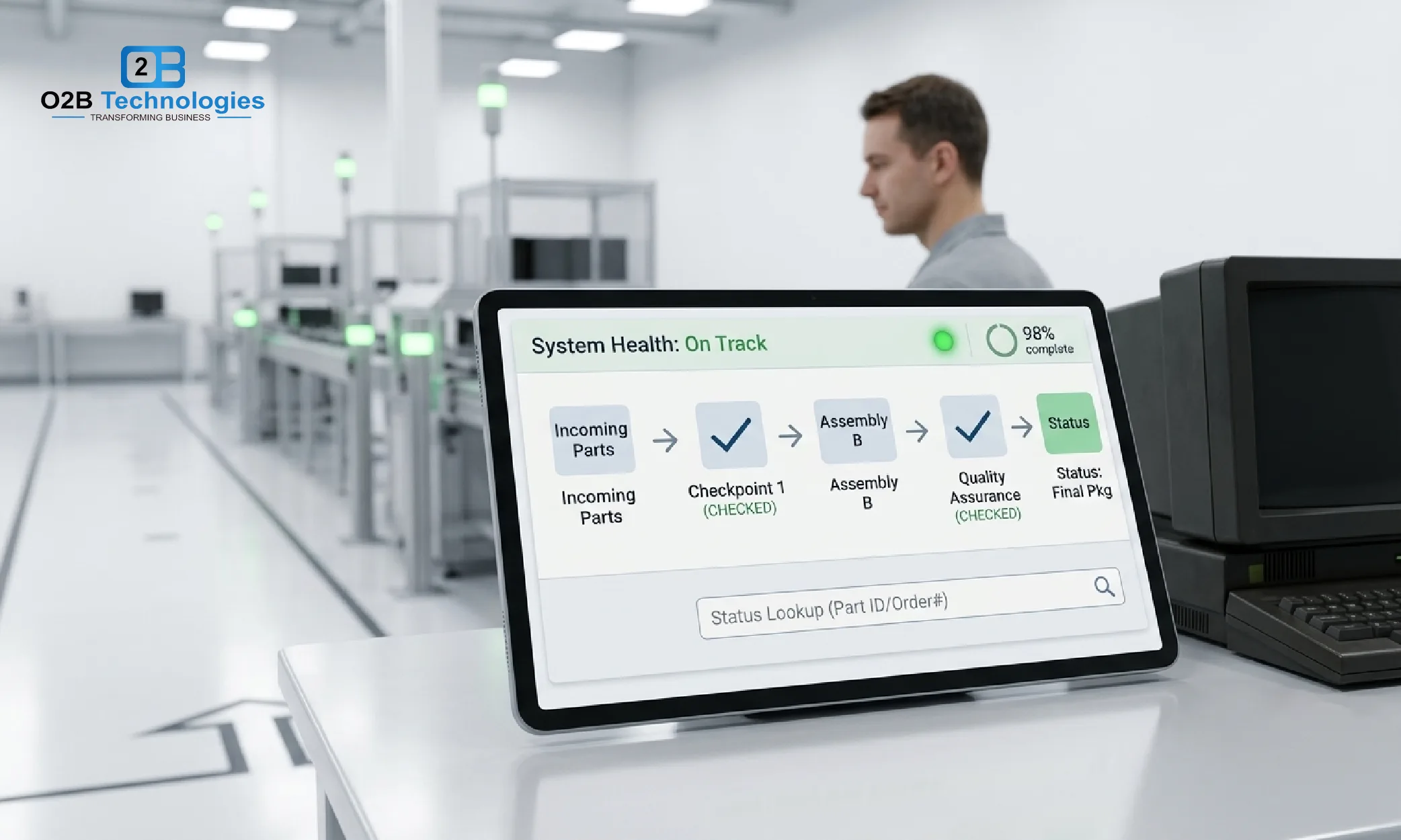
Manufacturing Flow
For this client, the real complexity didn't start until an order was marked "Ready for Production."
Client Overview
Industry: Discrete Manufacturing Focus Area: Post-Production Workflow Management
From there, it had to move through a maze of work centers, subcomponent fabrication, assembly stations, and trip-based dispatch all coordinated, in practice, by hand.
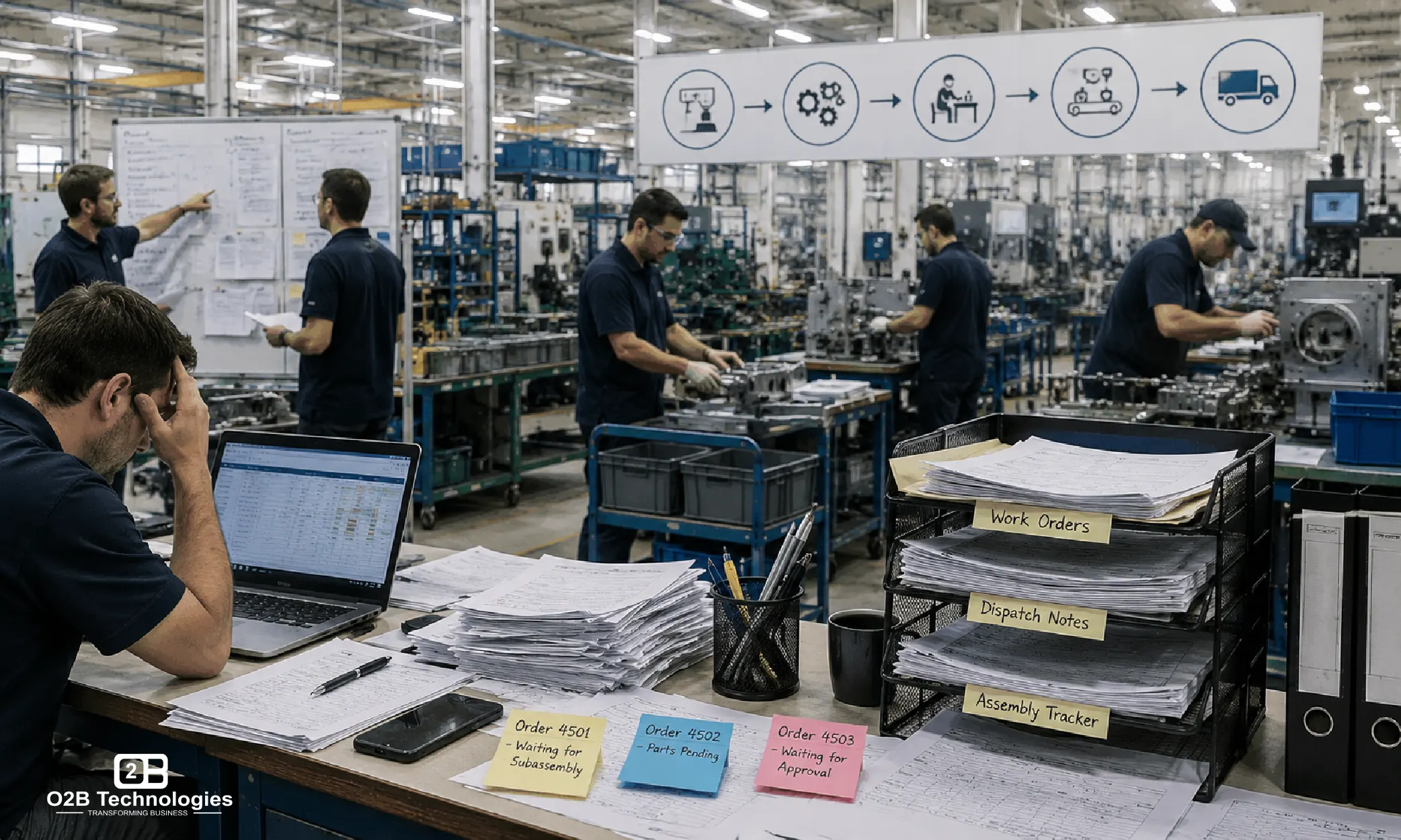
There wasn't a system pulling this together. People were tracking orders through spreadsheets, verbal check-ins, and whatever notes happened to be on hand. It worked, in the sense that production still shipped, but it worked the way things do when everyone's compensating for missing infrastructure slower than it should be, and one bad handoff away from a real problem.
Challenges
A few issues kept showing up, week after week.
Subcomponents and final assemblies weren't clearly linked. Everyone knew, informally, that certain parts needed to be ready before certain assemblies could start but nothing enforced that. It lived in people's heads, which meant it broke down the moment someone was out sick or a shift changed.
Work centers operated more or less independently. Production had to pass through several of them in sequence, but there was no defined routing telling anyone how an order should move from one to the next. Handoffs happened, but inconsistently, and tracing where something actually was could take longer than it should have.
Nobody had a fast answer to "where's this order right now?" Status by trip, by work center, by worker none of it lived in one place. Getting an answer usually meant walking the floor or making a few calls.
Planning suffered as a result. Without a shared view of what was happening across the shop, planners were scheduling somewhat blind, reacting to problems instead of anticipating them.
And maybe the riskiest gap: Manufacturing Orders moved to the next stage without anyone formally checking them first. Nothing malicious about it there just wasn't a checkpoint built into the process. Errors that could've been caught early had a way of carrying forward instead.
None of these problems were dramatic on their own. Together, they added up to a process that depended entirely on people remembering things correctly, every time.
What We Built
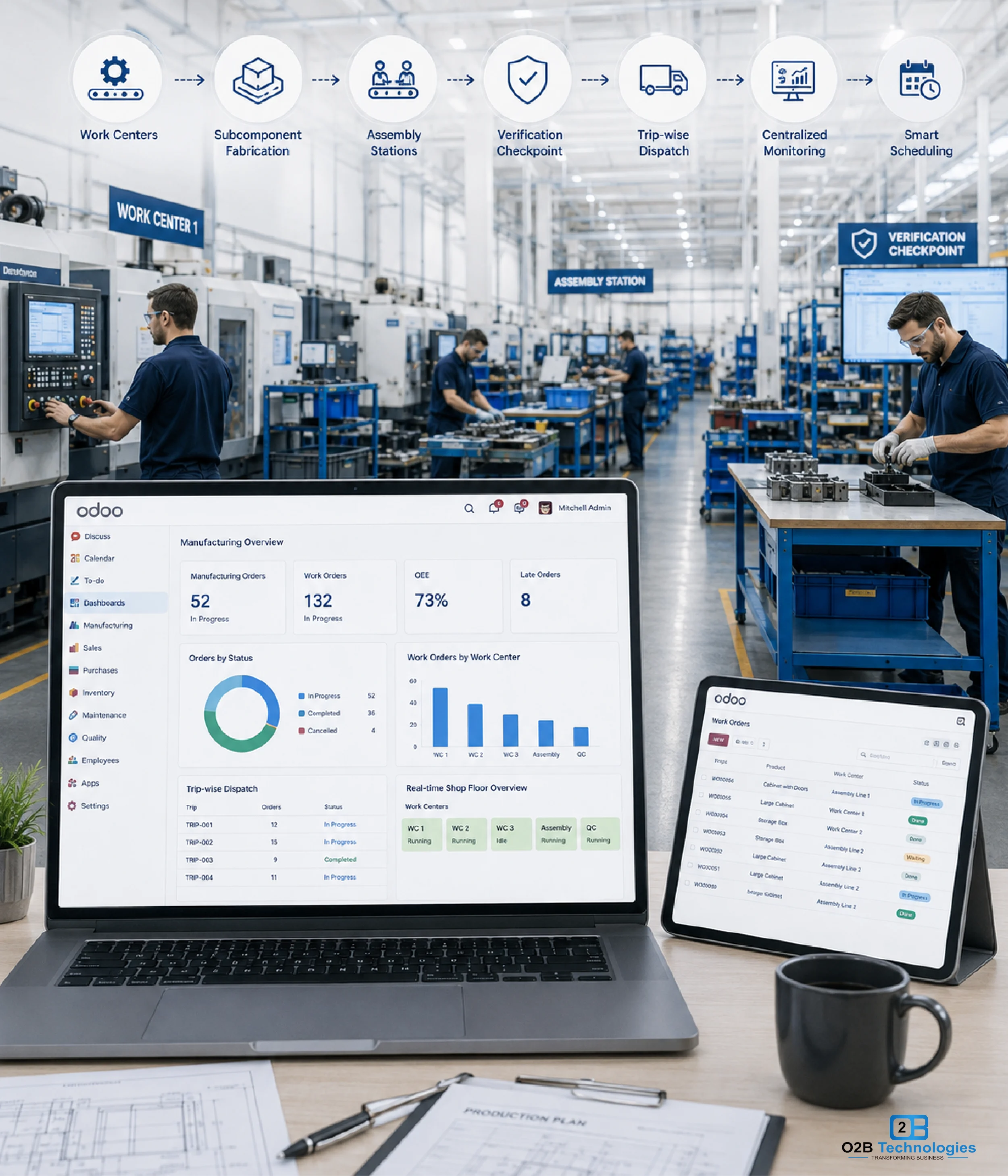
The goal wasn't to bolt more tracking onto the existing habits it was to rebuild the workflow so it actually matched how production really happened.
We set up dedicated work center operations with clear routing, so an order's path from one stage to the next was defined instead of assumed. Subcomponent production was tied directly to the assemblies it fed into, so those dependencies became something the system tracked rather than something people had to remember.
We added a verification step before Manufacturing Orders could move forward a real checkpoint, not just a formality, meant to catch problems before they traveled downstream.
Because orders were also grouped into trips for dispatch, we built trip-wise tracking so those groups could be monitored as a unit, not pieced together order by order. And we centralized status monitoring across trips, work centers, and workers, so the answer to "where's this order?" became something anyone could look up rather than something they had to chase down.
Finally, we gave planners a proper view into scheduling one grounded in what was actually happening on the floor, not secondhand updates.
The Outcome
-
The shift here wasn't flashy, but it mattered. The client went from a process held together by memory and manual follow-up to one where the system itself carried that weight.
-
Dependencies between parts and assemblies are now explicit. Work centers follow a defined path instead of an improvised one. Orders get checked before they advance, not after something's already gone wrong. And status by trip, by center, by worker is something people can just look up, instead of something they have to hunt for.
-
It's a quieter kind of improvement than a big number on a slide, but it's the kind that shows up every day on the floor: fewer surprises, faster answers, and a production process that finally reflects how the work actually gets done.